

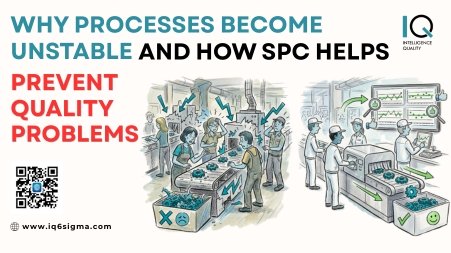
In every manufacturing environment, stability is often taken for granted until problems begin to surface. A production line that was performing efficiently yesterday suddenly starts showing increased rejection, inconsistent measurements, customer complaints, or rising rework. What makes this situation particularly frustrating for organizations is that, in many cases, nothing appears to have changed visibly. The same machines are running, the same materials are being used, and the same operators are carrying out the process. Yet the output begins to fluctuate.
This is one of the most important realities of manufacturing: processes rarely fail instantly. Most processes become unstable gradually, and long before major quality failures occur, subtle warning signs usually exist within the process itself. The challenge for organizations is not merely correcting defects after they happen, but recognizing instability early enough to prevent those defects from occurring in the first place.
This is where Statistical Process Control (SPC) continues to play a critical role in modern manufacturing systems.
A stable process is one that performs predictably over time. While no manufacturing process can produce perfectly identical output indefinitely, a controlled process operates within an expected range of variation. The moment variation begins behaving abnormally, the process starts moving toward instability.
Process instability occurs when output variation is no longer predictable. Measurements begin drifting unexpectedly, fluctuations increase, or patterns emerge that indicate the process is being influenced by abnormal conditions rather than natural variation alone.
For manufacturers, instability is dangerous because it directly affects consistency. Once consistency is lost, product quality, productivity, delivery performance, and customer satisfaction all become vulnerable.
There is rarely a single reason behind process instability. In most organizations, instability develops through the combined influence of multiple operational factors.
Machines naturally change over time. Components wear out, alignment shifts, vibration increases, and tooling gradually loses precision. Even highly advanced equipment cannot maintain identical performance indefinitely without monitoring and maintenance.
For example, in a machining operation, gradual tool wear may initially create only minor dimensional shifts. Because the variation develops slowly, operators may not immediately recognize the change. However, as the process continues drifting, rejection levels eventually increase significantly.
Many organizations only react once defects become visible, even though the process may have been signaling deterioration much earlier.
Even when raw materials meet specified standards, slight differences between batches can influence process behavior.
Changes in:
can introduce variation into otherwise stable operations.
In industries such as automotive, plastics, pharmaceuticals, or precision engineering, even small material inconsistencies can create measurable effects on process output.
Processes also become unstable when standardization is weak. Different operators may adjust settings differently, follow inconsistent methods, or interpret procedures in their own way.
Without disciplined process control, variability increases not because the system itself is incapable, but because the execution of the process is inconsistent.
This highlights an important principle often overlooked in manufacturing:
stable processes require stable methods.
One of the most common causes of instability is unnecessary adjustment.
When operators react emotionally to small fluctuations rather than understanding natural process variation, they may continuously alter:
Ironically, excessive adjustments often create more instability instead of improving performance.
This phenomenon is common in organizations that lack data-driven process monitoring.
In some situations, the process itself may actually be stable while the measurement system is not.
Poor calibration, inconsistent inspection techniques, worn gauges, or operator measurement differences can create the illusion of process instability.
As a result, organizations sometimes make incorrect process decisions based on unreliable data.
This is why effective quality management always requires confidence not only in the process, but also in the measurement system being used to evaluate it.
Traditional quality systems often depend heavily on inspection after production. In such environments, quality problems are identified only after:
By this stage, the organization has already incurred significant costs.
The financial impact extends beyond scrap alone. Delayed detection affects:
Reactive quality management is expensive because the organization responds only after failure becomes visible.
Modern manufacturing increasingly requires a preventive approach rather than a corrective one.
Statistical Process Control was developed to address this exact challenge.
Rather than focusing only on product inspection, SPC focuses on monitoring the process itself. By analyzing process data over time, organizations can identify unusual variation before defects escalate into major quality issues.
At its core, SPC helps answer a critical operational question:
Is the process behaving normally, or is something beginning to change?
This distinction is extremely important because every process contains natural variation. SPC helps organizations separate expected variation from abnormal variation requiring investigation.
Without this understanding, teams often make poor decisions:
SPC provides clarity through data.
The true value of SPC is not simply in creating charts or recording measurements. Its value lies in developing process awareness.
When applied effectively, SPC enables organizations to identify:
before large-scale rejection occurs.
Consider a bearing manufacturing process where shaft diameters are monitored periodically throughout production. Initially, measurements remain centered and stable. Over time, however, the data begins showing a gradual upward trend.
Even though products may still remain within specification, SPC reveals that the process is slowly drifting.
This early signal allows the team to investigate potential causes such as:
Corrective action can then be taken before actual defects are produced in large quantities.
Without SPC, the same issue may only become visible after significant rejection has already occurred.
One of the most important contributions of SPC is the shift it creates in organizational thinking.
Traditional inspection-based systems ask:
“How many defects were found?”
SPC-based systems ask:
“What is happening inside the process?”
This change is fundamental.
Organizations that mature in quality management gradually move away from defect detection and toward process understanding. Instead of relying entirely on final inspection, they focus on maintaining process stability throughout production.
This approach aligns strongly with Lean Manufacturing and continuous improvement principles, where the objective is not simply correcting problems, but preventing them from occurring repeatedly.
Despite its importance, SPC is still misunderstood in many organizations.
Some companies treat SPC merely as an audit requirement or documentation exercise. Charts are updated routinely, yet abnormal trends receive little attention.
In other cases, SPC becomes overly technical and disconnected from the shop floor. Operators may record data without fully understanding what the charts are indicating or why the information matters.
Successful SPC implementation requires more than statistical tools. It requires:
SPC is most effective when it becomes part of daily operational decision-making rather than a quality department activity alone.
As manufacturing environments become increasingly competitive, organizations can no longer depend solely on inspection to maintain quality. Customers expect consistency, reliability, and repeatability.
Achieving those expectations requires stable processes.
Statistical Process Control remains one of the most practical and effective methods for understanding process behavior, reducing variation, and preventing quality problems before they become costly.
Ultimately, SPC is not just about statistics.
It is about developing the ability to listen to what the process is trying to tell us - before failure occurs.