

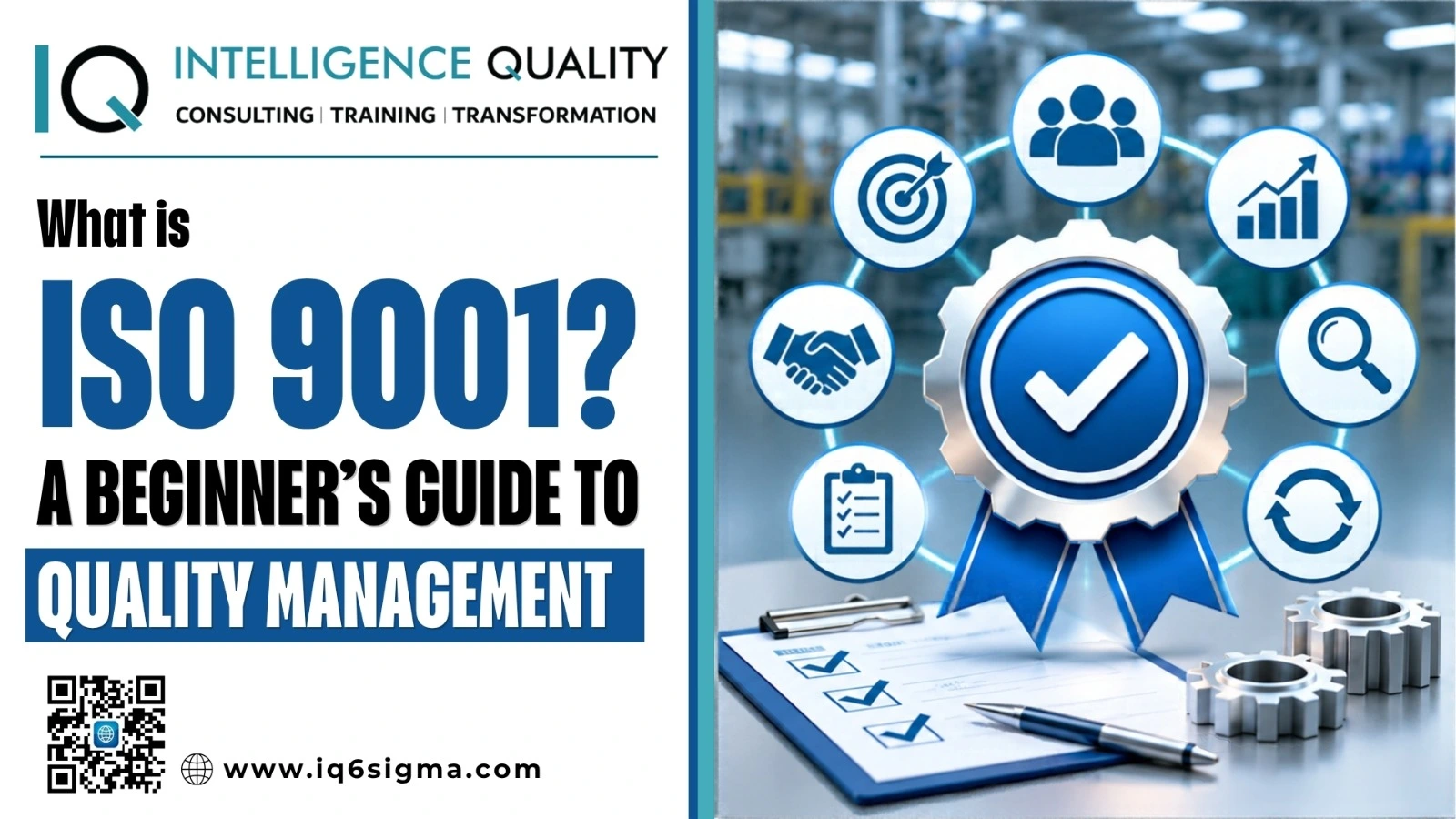
If you have come across terms such as Quality Management System (QMS), ISO certification, quality assurance, or continual improvement, you have probably encountered ISO 9001.
But what exactly is ISO 9001, and why do organizations use it?
In simple terms, ISO 9001 is an international standard that sets requirements for a Quality Management System (QMS). It helps organizations establish consistent processes, understand customer requirements, manage risks, monitor performance, and continually improve how they work. The current edition is ISO 9001:2026, which builds on the principles of quality management while addressing the changing needs of modern organizations.
ISO 9001 is a standard developed by the International Organization for Standardization (ISO) for Quality Management Systems.
It provides a structured framework that organizations can use to make sure their processes are controlled, consistent, and focused on delivering products and services that meet customer and applicable requirements.
Importantly, ISO 9001 does not prescribe exactly how a company must operate. Instead, it establishes requirements that an organization can adapt to its own size, industry, processes, and business objectives.
A Quality Management System is the way an organization defines, manages, monitors, and improves the processes that affect the quality of its products or services.
It is not simply a collection of documents.
A functioning QMS connects areas such as:
The objective is to create a systematic approach to managing quality rather than relying on individual effort or reacting to problems after they occur.
Organizations operate in environments where customer expectations, regulations, technology, suppliers, and market conditions can change quickly.
ISO 9001 provides a framework for managing these changes systematically.
A well-implemented QMS can help organizations:
However, ISO 9001 certification by itself does not guarantee that every product or service will be defect-free. Its value comes from how effectively the organization implements and maintains its QMS.
ISO 9001 is based on seven quality management principles:
These principles help organizations move from simply "checking quality" to building quality into the way work is performed.
ISO 9001 requirements are organized around key areas of a Quality Management System, including:
Context of the Organization: Organizations need to understand their internal and external context, relevant interested parties, and the scope of their QMS.
Leadership: Top management has an important role in establishing quality direction, responsibilities, and commitment.
Planning: Organizations address risks and opportunities, establish quality objectives, and plan how those objectives will be achieved.
Support: This includes resources, competence, awareness, communication, and documented information required to support the QMS.
Operation: Organizations plan and control the processes needed to deliver products and services and meet applicable requirements.
Performance Evaluation: Organizations monitor, measure, analyse, and evaluate QMS performance through activities such as monitoring, customer feedback, and internal audits.
Improvement: When problems occur, organizations need to address nonconformities, determine appropriate corrective action, and continually improve the suitability, adequacy, and effectiveness of the QMS.
One of the biggest advantages of ISO 9001 is its broad applicability.
It can be used by organizations of different sizes and across many sectors, including:
The standard is designed to be adaptable rather than limited to one particular industry.
ISO 9001 certification is an independent assessment of an organization's Quality Management System against the requirements of ISO 9001.
If the organization successfully meets the applicable requirements, an accredited certification body can issue an ISO 9001 certificate.
This distinction is important:
An organization can be ISO 9001 certified. An individual does not become "ISO 9001 certified" in the same way.
Individuals can, however, undertake ISO 9001 training and earn qualifications or certificates for programs such as ISO 9001 Internal Auditor or ISO 9001 Lead Auditor, depending on the training and certification arrangement.
These two are often confused.
ISO 9001 certification evaluates an organization's QMS.
ISO 9001 training develops an individual's knowledge and skills related to the standard.
For example, someone working in quality may take ISO 9001 Internal Auditor training to learn how to plan, conduct, report, and follow up internal audits.
Someone responsible for implementing a QMS may instead benefit from ISO 9001 implementation-focused training.
No. Documentation is one part of a QMS, but ISO 9001 is fundamentally about managing processes and achieving intended results.
A company can have extensive procedures and still have an ineffective QMS if employees do not follow the processes, performance is not monitored, problems are not addressed, or improvement does not take place.
The real question is not: "Do we have documents?"
It is: "Are our processes controlled, effective, and continually improving?"
ISO 9001:2026 is the latest edition of the standard and reflects the evolving business environment in which organizations operate.
Organizations working with ISO 9001 should therefore understand which requirements have changed, how those changes affect their existing QMS, and what actions may be necessary during the transition.
For professionals, this also makes choosing ISO 9001:2026 training particularly important when developing current knowledge of the standard.
For an organization, ISO 9001 can provide a structured approach to managing quality, customer requirements, risks, processes, and improvement.
For professionals, understanding ISO 9001 can be valuable for careers in:
The real value, however, comes from applying the principles effectively rather than treating ISO 9001 as a certificate exercise.
Think of ISO 9001 as a management framework for making quality part of the way an organization works.
It encourages organizations to ask:
What do our customers and other relevant interested parties expect?
↓
How do our processes deliver those requirements?
↓
How do we know our processes are working?
↓
What happens when something goes wrong?
↓
What can we improve?
That cycle is at the heart of effective quality management.
ISO 9001 is more than a quality certificate. It provides a systematic framework for organizations to manage processes, meet requirements, evaluate performance, address problems, and improve continuously.
Whether you are a business owner, quality professional, auditor, operations manager, or someone beginning a career in quality, understanding ISO 9001 is a useful starting point for understanding modern Quality Management Systems.
In simple terms: ISO 9001 helps organizations build a consistent, customer-focused, and improvement-driven approach to managing quality.
Choosing the right ISO 9001 training course requires more than comparing fees and course d...
Read More
Discover how Artificial Intelligence enhances Lean Six Sigma and DMAIC methodology. Learn ...
Read More
Discover 7 key ISO 9001:2026 changes, including leadership, risk management, quality cultu...
Read More