On this page
Understanding ISO 9001 can seem complicated when you first encounter its clauses, terminology, and requirements. However, the standard becomes much easier to understand when each requirement is connected to something an organization actually does.
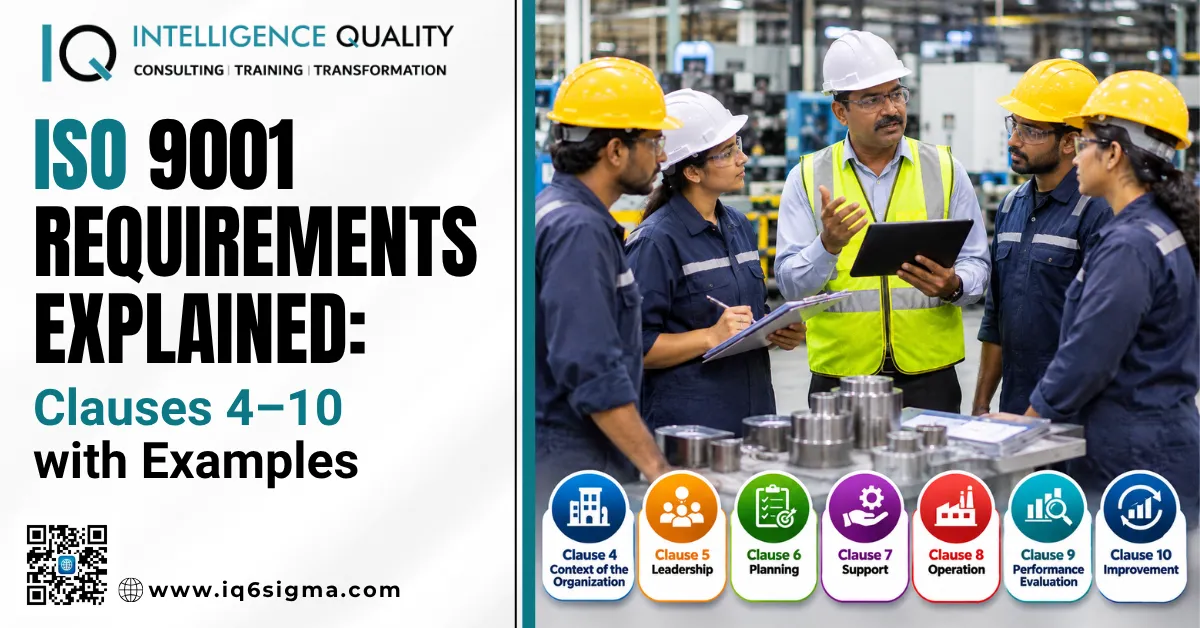
The core requirements of an ISO 9001 Quality Management System are covered in Clauses 4 to 10. Together, they address the organization's context, leadership, planning, support, operations, performance evaluation, and improvement.. If you are just starting out, exploring a beginner's guide to ISO 9001 and quality management will help set the foundation before diving into the individual clauses.
This guide explains each clause in simple terms and provides practical examples of how the requirements can be applied.
What Are Clauses 4–10 of ISO 9001?
ISO 9001 Clauses 4–10 contain the requirements that organizations need to address when establishing, implementing, maintaining, and continually improving a Quality Management System (QMS).
The clauses cover:
| Clause | Main Focus |
| Clause 4 | Context of the organization |
| Clause 5 | Leadership |
| Clause 6 | Planning |
| Clause 7 | Support |
| Clause 8 | Operation |
| Clause 9 | Performance evaluation |
| Clause 10 | Improvement |
The requirements are interconnected. An organization first needs to understand its environment and requirements, establish leadership and objectives, provide the necessary resources, control its operations, evaluate performance, and then improve where necessary.
Clause 4: Context of the Organization
What does Clause 4 require?
Clause 4 requires an organization to understand the factors that can influence its ability to achieve the intended results of its Quality Management System.
This includes understanding:
- Internal and external issues
- Relevant interested parties
- Their relevant requirements
- The scope of the QMS
- The processes needed for the QMS and how they interact
The organization should not look at quality in isolation. Business conditions, customers, suppliers, regulations, technology, employees, and other factors all shape how effectively the QMS performs—a dynamic that also drives the key changes in ISO 9001:2026.
Example
A manufacturing company is experiencing increasing customer complaints because customers expect shorter delivery times.
The organization may identify:
- Customer delivery expectations as an external issue
- Production capacity as an internal issue
- Customers as a relevant interested party
- Delivery performance as a key process indicator
The organization can then consider these factors when defining and improving its QMS.
In simple terms:
Clause 4 asks: "What affects our ability to deliver quality consistently?"
Clause 5: Leadership
What does Clause 5 require?
Quality management cannot be treated as the responsibility of the quality department alone. Clause 5 places emphasis on top management leadership and commitment.
Leadership is expected to ensure that the QMS is integrated into the organization's business processes and that customer focus is maintained.
Responsibilities, authorities, and relevant quality roles also need to be established and communicated.
Example
A company's quality manager identifies a recurring production problem. Instead of asking the quality team to solve it alone, top management reviews the issue, allocates resources, involves production and engineering teams, and monitors the improvement plan.
This demonstrates that quality is being treated as a business responsibility rather than simply a quality-department activity.
In simple terms:
Clause 5 asks: "Is leadership actively driving quality?"
Clause 6: Planning
What does Clause 6 require?
Once an organization understands its context and leadership responsibilities, it needs to plan how the QMS will achieve its intended results.
Clause 6 addresses areas such as:
- Risks and opportunities
- Quality objectives
- Planning to achieve those objectives
- Planning of changes to the QMS
The objective is to encourage organizations to think ahead rather than simply react when problems occur.
Example
A company identifies a risk that a critical raw-material supplier may experience supply interruptions.
Instead of waiting for a shortage, it could:
- Evaluate the supplier risk
- Identify alternative suppliers
- Define appropriate controls
- Monitor supplier performance
- Establish contingency arrangements
The exact action will depend on the organization's circumstances and the significance of the risk.
In simple terms:
Clause 6 asks: "What could affect our results, and how are we planning for it?"
Clause 7: Support
What does Clause 7 require?
Even a well-designed QMS cannot work without the necessary resources and support.
Clause 7 addresses areas including:
- Resources
- People
- Infrastructure
- Environment for operation of processes
- Monitoring and measuring resources
- Organizational knowledge
- Competence
- Awareness
- Communication
- Documented information
The organization needs to determine and provide what is necessary for its processes to operate effectively.
Example
A company introduces a new inspection process.
Before implementing it, the organization may need to ensure that:
- Employees build the required competence through structured ISO 9001 training and certification
- Required inspection equipment is available
- Measuring equipment is appropriately controlled
- Employees understand the quality requirements
- Relevant procedures or documented information are available
Simply issuing a new procedure does not guarantee that employees can perform the process effectively.
In simple terms:
Clause 7 asks: "Do our people, resources, knowledge, and information support quality?"
Clause 8: Operation
What does Clause 8 require?
Clause 8 is where many QMS requirements connect directly with day-to-day operations.
It covers the planning and control of processes needed to provide products and services that meet requirements.
Depending on the organization, this can include:
- Determining customer and applicable requirements
- Design and development
- Control of externally provided processes, products, and services
- Production and service provision
- Identification and traceability
- Preservation
- Release of products and services
- Control of nonconforming outputs
Not every organization will have every type of operational activity. For example, design and development requirements may not apply to an organization that does not undertake design and development within the scope of its QMS.
Example
A manufacturer receives an order with specific dimensional requirements.
Before production, the organization should ensure that the requirements are understood and that the relevant production and inspection processes are capable of meeting them.
During production, appropriate controls and inspections are applied. Before release, the required verification is completed.
If a product does not meet requirements, it is controlled so that it is not unintentionally delivered.
In simple terms:
Clause 8 asks: "Are we controlling the processes that create and deliver our products or services?"
Clause 9: Performance Evaluation
What does Clause 9 require?
An organization needs to know whether its QMS is actually working.
Clause 9 addresses monitoring, measurement, analysis, and evaluation, along with:
- Customer satisfaction
- Internal audits
- Management review
- Evaluation of QMS performance
Simply collecting data is not enough. Organizations need to determine what the information means and use it to support decisions.
Example
A company tracks:
- Customer complaints
- On-time delivery
- Product rejection rates
- Supplier performance
- Internal audit findings
The management team reviews these results and identifies that late deliveries have increased significantly over several months.
Rather than treating the data as a report-only exercise, management investigates the reasons and decides what action is required.
In simple terms:
Clause 9 asks: "How do we know whether our QMS is performing effectively?"
Clause 10: Improvement
What does Clause 10 require?
No QMS remains effective simply because it was established once.
Clause 10 focuses on improvement, including:
- Addressing nonconformities
- Taking appropriate corrective action
- Continually improving the suitability, adequacy, and effectiveness of the QMS
When something goes wrong, the objective should not simply be to correct the immediate problem. The organization should determine whether action is needed to eliminate the cause and prevent recurrence. In fact, many organizations combine QMS corrective actions with structured problem-solving methods because ISO certification strengthens the ROI of Lean Six Sigma projects.
Example
A customer receives a product with an incorrect specification. A quick correction might be to replace the product.
However, the organization should also investigate why the error occurred.
The investigation might identify that an outdated specification was being used in production.
The corrective action could then involve improving document control and verifying that current specifications are available at the point of use.
In simple terms:
Clause 10 asks: "When something goes wrong, are we fixing the cause and improving the system?"
How Clauses 4–10 Work Together
The seven clauses should not be viewed as seven independent requirements.
They form a connected management cycle:
Clause 4 - Understand the organization
↓
Clause 5 - Establish leadership and customer focus
↓
Clause 6 - Plan for risks, opportunities, and objectives
↓
Clause 7 - Provide the necessary support
↓
Clause 8 - Control operations
↓
Clause 9 - Evaluate performance
↓
Clause 10 - Correct, improve, and learn
This connection is important when implementing or auditing a QMS. A weakness in one area can affect another.
For example, poor planning under Clause 6 can create operational problems under Clause 8. Those problems may later appear through performance evaluation under Clause 9 and require corrective action under Clause 10.
Are Clauses 4–10 the Same for Every Organization?
The requirements of ISO 9001 apply broadly, but their implementation will vary.
A small service company will not necessarily have the same processes, resources, risks, or documented information as a large manufacturing organization.
ISO 9001 is designed to be applicable across different types and sizes of organizations. The QMS should reflect the organization's actual operations and circumstances.
This is why effective ISO 9001 implementation is not about creating paperwork simply to satisfy an auditor. It is about establishing controls that make sense for the organization's processes and objectives.
What Do Auditors Look for in Clauses 4–10?
An ISO 9001 auditor does not simply check whether a document exists.
Auditors typically look for objective evidence that the organization's processes meet applicable requirements and are effectively implemented.
Depending on the clause and organization, this could include:
- Process information
- Objectives and performance results
- Risk-related information
- Training and competence records
- Supplier evaluations
- Customer feedback
- Operational records
- Internal audit results
- Management review outputs
- Nonconformity and corrective-action records
The evidence should demonstrate how the organization's QMS operates in practice. Professionals looking to master how to evaluate this evidence can build hands-on auditing skills through an ISO 9001 Lead Auditor course.
A Simple Way to Remember ISO 9001 Clauses 4–10
If you are new to ISO 9001, remember the clauses as a sequence:
- 4 - Understand: What is happening around the organization?
- 5 - Lead: Who is responsible for quality?
- 6 - Plan: What risks, opportunities, and objectives need to be addressed?
- 7 - Support: What people, resources, knowledge, and information are needed?
- 8 - Operate: How are products and services delivered?
- 9 - Evaluate: How do we know the system is working?
- 10 - Improve: What needs to be corrected or improved?
This simple framework can make the structure of ISO 9001 much easier to understand.
Final Takeaway
ISO 9001 Clauses 4–10 provide a structured approach to managing quality, from understanding the organization's environment and establishing leadership to controlling operations, evaluating performance, and driving improvement.
The most important point is that ISO 9001 should be implemented as a management system, not treated as a documentation exercise. When the requirements are connected to real business processes, they become much easier to understand and far more valuable to the organization.
For professionals working in quality, operations, compliance, or auditing, mastering how Clauses 4–10 connect is essential—and enrolling in ISO 9001:2026 training & certification helps translate these requirements into audit-ready execution.