

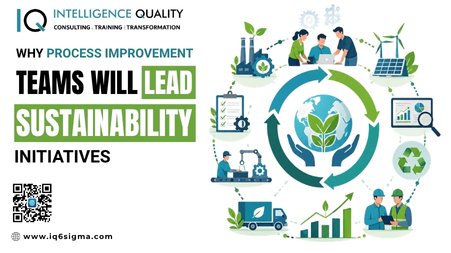
"Sustainability isn't just about planting more trees or reducing plastic. It starts with improving the way we work."
For years, sustainability was often viewed as the responsibility of Environmental, Health & Safety (EHS) teams or Corporate Social Responsibility (CSR) departments. Process improvement teams focused on productivity, quality, and cost, while sustainability teams concentrated on reducing environmental impact and meeting compliance requirements.
Today, those worlds are rapidly coming together.
Organizations are beginning to realize that many of their sustainability goals can only be achieved by improving the processes that create waste in the first place. Whether it's reducing energy consumption, minimizing scrap, lowering water usage, or improving resource efficiency, sustainable outcomes are often the result of better operational processes.
This is why Process Improvement teams, armed with Lean Six Sigma, Operational Excellence, and continuous improvement methodologies are becoming some of the most influential drivers of sustainability initiatives.
When people hear the word sustainability, they often think about renewable energy, electric vehicles, or carbon offsets.
While these initiatives are important, they address only part of the picture.
The everyday decisions made on factory floors, in warehouses, offices, hospitals, and service organizations have an equally significant impact. Every unnecessary movement, every defective product, every machine left running, every excess inventory item, and every avoidable delay consumes resources that cannot be recovered.
Improving these processes reduces waste - not only in terms of time and cost, but also in energy, materials, emissions, and natural resources.
In many ways, organizations become more sustainable by becoming more efficient.
Long before sustainability became a global priority, Lean thinking encouraged organizations to eliminate activities that added no value.
The well-known eight wastes of Lean - defects, overproduction, waiting, non-utilized talent, transportation, inventory, motion, and extra processing, represent more than operational inefficiencies.
Each one also carries an environmental cost.
Consider a simple example:
A defective product doesn't just require rework. It has already consumed raw materials, electricity, machine time, packaging, transportation, and labor. If it must be scrapped, those resources are lost, and additional resources are needed to produce a replacement.
Reducing defects therefore improves quality while simultaneously reducing environmental impact.
The same principle applies across every type of waste.
A process improvement project aimed at reducing waste often delivers sustainability benefits without changing its primary objective.
Environmental, Social, and Governance (ESG) objectives are becoming an important part of business strategy.
Organizations are setting ambitious targets to reduce carbon emissions, improve resource efficiency, strengthen workplace safety, and create long-term value for stakeholders.
Interestingly, many of these objectives align naturally with the work Process Improvement teams already perform.
For example:
What were once considered productivity improvements are now recognized as meaningful sustainability initiatives.
Successful sustainability programs depend on one critical factor: reliable data.
Organizations must measure energy usage, waste generation, emissions, process efficiency, water consumption, recycling rates, and many other performance indicators.
This is familiar territory for Lean Six Sigma professionals.
Process Improvement teams already rely on data to identify variation, measure performance, verify root causes, and validate improvements.
They understand how to establish baselines, monitor key performance indicators, conduct statistical analysis, and ensure improvements are sustained over time.
This analytical mindset makes them well equipped to support sustainability reporting and evidence-based decision-making.
After all, improvements that cannot be measured cannot be managed.
Many sustainability programs begin with enthusiasm but gradually lose momentum.
Process Improvement teams approach change differently. Rather than relying on one-time campaigns, they focus on building systems that encourage continuous improvement.
Small improvements made consistently often create greater long-term impact than isolated large projects. Reducing energy usage by just 2% across hundreds of facilities may generate far greater environmental benefits than a single high-profile sustainability initiative.
Continuous improvement creates sustainable results because it becomes part of everyday work rather than an occasional project.
No single department can achieve sustainability goals alone.
Engineering, Operations, Procurement, Quality, Maintenance, Finance, Human Resources, and Supply Chain all contribute to the organization's environmental and operational performance.
Process Improvement teams naturally work across these functions.
Their role has always involved bringing people together, understanding end-to-end processes, identifying opportunities, and helping different departments solve shared problems.
This cross-functional perspective makes them ideal facilitators for sustainability initiatives that require organization-wide collaboration.
Modern technologies are giving Process Improvement teams new ways to identify and reduce waste. Smart sensors monitor energy consumption in real time. Industrial Internet of Things (IIoT) devices detect inefficiencies before they become costly problems.
Artificial Intelligence identifies patterns that would otherwise remain hidden. Digital dashboards provide instant visibility into process performance and resource utilization.
Combined with Lean Six Sigma methodologies, these technologies allow organizations to make faster, smarter, and more sustainable decisions.
Technology provides the information. Process Improvement provides the methodology.
Together, they create measurable impact.
As sustainability becomes integrated into operational excellence, the role of Process Improvement professionals continues to evolve.
Beyond traditional Lean Six Sigma skills, future leaders will increasingly benefit from understanding:
The professionals who combine operational excellence with sustainability knowledge will be well positioned to lead transformation across industries.
The role of Process Improvement teams is expanding.
Organizations no longer expect them to simply reduce cycle time or improve productivity. They are increasingly expected to help businesses become more resilient, resource-efficient, and environmentally responsible.
Every successful Lean project that eliminates waste, every Six Sigma project that reduces variation, and every Operational Excellence initiative that improves efficiency contributes to a more sustainable organization.
In many ways, sustainability is not a new destination for Process Improvement - it is a natural extension of the work these teams have always done.
The most successful sustainability initiatives are rarely built on grand promises alone. They are built on thousands of practical improvements made every day by people who understand processes, measure performance, and solve problems systematically.
That is precisely what Process Improvement teams do.
As organizations continue balancing profitability with environmental and social responsibility, these teams will play an increasingly central role, not because sustainability has replaced operational excellence, but because the two are becoming inseparable.
The future belongs to organizations that recognize a simple but powerful truth:
Every process improved is a step toward a more sustainable business.