

In today's digital world, online learning is everywhere. With just a few clicks, anyone can enroll in a Lean Six Sigma course, watch recorded videos, and earn a certificate from the comfort of home.
But when it comes to mastering Lean Six Sigma, not just understanding the concepts, but learning how to solve real business problems - there is still something that technology struggles to replace: the classroom experience.
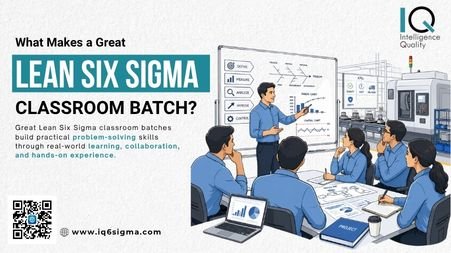
A great Lean Six Sigma classroom batch is much more than a training program. It is an environment where professionals challenge each other's thinking, learn from real industry experiences, practice problem-solving together, and build relationships that continue long after the course ends.
The difference isn't just how you learn. It's how deeply you understand, apply, and retain that learning.
Anyone can read about DMAIC, Value Stream Mapping, or Statistical Process Control in a book.
The real challenge begins when you're faced with a production issue, inconsistent customer complaints, or a process that's failing to meet expectations. Suddenly, the question isn't "What does the tool do?" but "Which tool should I use, and why?"
This is where classroom learning shines.
An experienced trainer doesn't simply explain the methodology, they share practical insights gained from years of solving problems across industries. Participants can ask questions, discuss different approaches, and understand the reasoning behind each decision.
Often, the most valuable lessons come from conversations that were never part of the original presentation.
One of the greatest strengths of a classroom batch is the diversity of experience sitting in the room.
Imagine a class that includes:
Although they work in different industries, many of their challenges are remarkably similar - reducing defects, improving efficiency, eliminating waste, and increasing customer satisfaction.
As participants share their projects and challenges, everyone gains fresh perspectives. A solution developed in one industry often sparks ideas that can be adapted in another.
This exchange of practical knowledge simply cannot be replicated through recorded videos.
One participant's question often answers the doubts of ten others.
During classroom discussions, learners hear different viewpoints, alternative methods, and practical examples that enrich everyone's understanding.
Sometimes the trainer may demonstrate multiple ways to approach the same problem, encouraging participants to think critically instead of memorizing steps.
Lean Six Sigma is about problem-solving, and problem-solving begins with asking better questions.
Reading about a Pareto Chart is useful. Creating one from actual data is far more valuable.
Interpreting the results and deciding what action to take is where real learning happens.
An effective classroom batch includes practical exercises, simulations, case studies, group activities, and data analysis sessions that allow participants to apply concepts immediately. Instead of simply learning what the tools are, participants discover when, why, and how to use them effectively.
That practical confidence becomes invaluable when leading improvement projects back in the workplace.
In self-paced online learning, misunderstandings can go unnoticed for days or even weeks. In a classroom, clarification happens instantly.
Whether it's understanding process capability, interpreting control charts, conducting hypothesis tests, or selecting the right improvement tool, participants receive immediate guidance from both the trainer and their peers.
Small misconceptions are corrected before they become habits.
The best Lean Six Sigma trainers rarely rely only on textbook examples.
Instead, they bring real projects from manufacturing plants, hospitals, logistics operations, financial institutions, IT companies, and service organizations.
Participants see how Lean Six Sigma is applied in real business environments, complete with the challenges, setbacks, and lessons learned along the way.
These stories make the methodology practical, relatable, and memorable.
A classroom batch also creates professional connections. Participants often stay connected long after the training ends, exchanging ideas, discussing improvement projects, sharing job opportunities, and seeking advice from one another. Many professionals discover future mentors, collaborators, or even career opportunities through the people they meet during training.
These relationships become an unexpected, but highly valuable - outcome of the learning experience.
It's easy to postpone an online lesson. It's much harder to postpone learning when you're part of an engaged classroom. Scheduled sessions encourage consistency, participation, and focus.
Group discussions motivate participants to prepare, contribute, and actively engage rather than passively consume information. This structured environment often leads to better completion rates and stronger knowledge retention.
While every training provider may have a different approach, the most effective Lean Six Sigma classroom programs tend to share several characteristics:
When these elements come together, participants don't just earn a certification - they develop the confidence to lead meaningful improvement initiatives.
Lean Six Sigma has always been about improving the way people work. Ironically, one of the best ways to learn it is also through people. Technology has transformed education and made learning more accessible than ever before. Online courses offer flexibility, convenience, and reach that were once unimaginable.
However, for professionals seeking deeper understanding, practical application, collaborative learning, and lasting professional relationships, the classroom continues to offer a unique advantage. Because in the end, Lean Six Sigma isn't simply about completing a course or collecting a certificate.
It's about developing the ability to solve problems, improve processes, and create measurable value, and that journey is often strongest when people learn, question, and grow together.