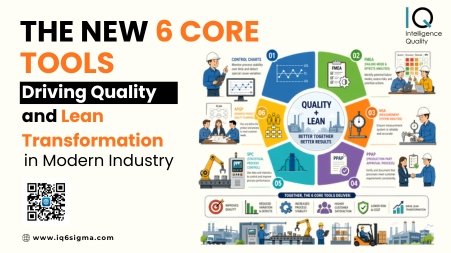
In today’s competitive industrial landscape, precision, efficiency, and reliability are critical for success. Organizations are increasingly leveraging the New 6 Core Tools to reduce defects, optimize processes, and drive continuous improvement. When combined with Lean principles, these tools create a powerful framework for operational excellence that delivers measurable results.
Understanding the New 6 Core Tools
Originally developed for the automotive industry to support quality management standards like IATF 16949, the New 6 Core Tools are now widely adopted across multiple sectors, including aerospace, electronics, healthcare, and services. These tools include:
- Advanced Product Quality Planning (APQP): A structured approach to plan and develop products that meet customer expectations. It emphasizes early risk identification and collaboration across design, manufacturing, quality, and supply chain teams. For example, automotive manufacturers use APQP to reduce launch delays and warranty claims by ensuring new components are production-ready from day one. Lean complements APQP by eliminating waste in planning processes and aligning value streams.
- Failure Mode and Effects Analysis (FMEA): A proactive method to identify potential failures, assess their impact, and prioritize corrective actions. Electronics and pharmaceutical companies apply FMEA to anticipate failures in circuit boards or processing steps, preventing costly defects. Lean principles enhance FMEA by emphasizing early elimination of non-value-added activities and reducing process variability.
- Measurement System Analysis (MSA): Ensures measurement systems are accurate and reliable, providing trustworthy data for quality decisions. Aerospace and precision machining industries rely on MSA to prevent false alarms and hidden defects. Lean reinforces MSA by using reliable data to drive process improvements and waste reduction.
- Statistical Process Control (SPC): Monitors processes in real time using statistical methods to detect trends and prevent defects. Beverage bottling plants, for instance, use SPC to monitor fill levels and packaging quality, minimizing scrap and rework. Lean focuses on stable, predictable processes, and SPC provides the visibility to achieve continuous flow.
- Production Part Approval Process (PPAP): Validates that engineering and manufacturing processes can consistently produce parts that meet specifications. Automotive suppliers rely on PPAP to ensure components meet OEM requirements, reducing nonconformance risk. Lean’s focus on standardization aligns with PPAP to minimize trial-and-error production starts.
- Problem Solving (8D & Structured Methodologies): Offers a systematic approach to identifying root causes, implementing corrective actions, and preventing recurrence. From assembly line bottlenecks to service delivery issues, structured problem-solving ensures long-term improvements. Lean complements this by embedding continuous improvement into everyday operations.
Why the New 6 Core Tools Remain Relevant in 2026
The need for consistent quality and operational efficiency has never been higher. Even in a world dominated by automation, AI, and digital transformation, human processes and decision-making remain prone to errors. The New 6 Core Tools provide a structured, data-driven approach to manage complexity, reduce defects, and ensure reliable outcomes.
Organizations across industries, from automotive and electronics to healthcare and finance, rely on these tools to align processes with business goals, mitigate risk, and enhance customer satisfaction. Lean principles amplify their effectiveness by emphasizing waste elimination, value creation, and employee engagement, turning structured tools into actionable improvements.
Lean and the 6 Core Tools: A Strategic Partnership
Lean creates the cultural and operational foundation for improvement, while the 6 Core Tools supply the analytical mechanisms. Together, they enable organizations to detect problems faster, reduce defects and rework, lower operational costs, and deliver higher customer satisfaction. Lean ensures that improvement initiatives are not only implemented but sustained, while the 6 Core Tools provide the rigor needed to measure and maintain performance.
Conclusion
In 2026, quality and operational excellence are more critical than ever. The New 6 Core Tools provide the structured framework necessary for consistent, reliable results, and Lean ensures those results are delivered efficiently and sustainably. For industries aiming to compete globally, reduce risk, and exceed customer expectations, mastering both Lean and the 6 Core Tools is no longer optional - it is essential.