

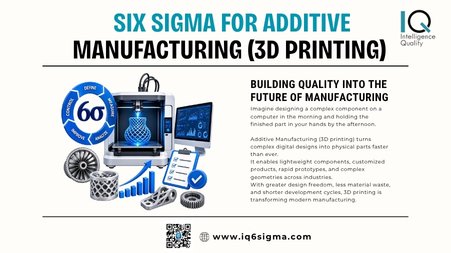
Imagine designing a complex component on a computer in the morning and holding the finished part in your hands by the afternoon. What once sounded like science fiction is now a reality thanks to Additive Manufacturing (AM), more commonly known as 3D printing.
From lightweight aerospace components and customized medical implants to automotive prototypes and intricate industrial tools, additive manufacturing is changing the way products are designed and produced. It offers unprecedented design freedom, shorter development cycles, reduced material waste, and the ability to manufacture parts that would be difficult or even impossible to create using traditional methods.
But as exciting as this technology is, one question continues to challenge manufacturers:
How do we ensure every printed part meets the same high quality standards?
This is where Six Sigma becomes a powerful partner.
While additive manufacturing is transforming production, Six Sigma provides the discipline needed to make that transformation consistent, reliable, and repeatable.
Unlike conventional manufacturing methods that remove material through cutting, drilling, or machining, additive manufacturing builds an object layer by layer using digital design files.
This approach offers several advantages:
These benefits have made additive manufacturing a valuable technology across industries such as aerospace, healthcare, automotive, energy, consumer products, and even construction.
However, producing a part is only half the challenge.
Producing the same high-quality part every time is what separates successful manufacturing from experimental production.
In traditional manufacturing, quality problems often become visible after machining, assembly, or inspection. In additive manufacturing, quality is built one microscopic layer at a time.
Even small variations during printing can significantly affect the final product.
Factors such as:
can all influence strength, surface finish, dimensional accuracy, and overall performance.
Managing so many variables simultaneously is a complex challenge.
Six Sigma provides the structured approach needed to understand and control this variation.
At its core, Six Sigma is about reducing variation.
Variation is also one of the biggest challenges in additive manufacturing.
Two parts printed from the same digital model may look identical, yet subtle process variations can lead to differences in mechanical strength, density, dimensional accuracy, or internal defects. Using the DMAIC methodology (Define, Measure, Analyze, Improve, and Control), organizations can systematically improve additive manufacturing processes.
For example:
Define
Identify the customer's critical quality requirements, such as strength, precision, surface finish, or weight.
Measure
Collect data on printing parameters, dimensional accuracy, build time, defect rates, and process capability.
Analyze
Determine which process variables contribute most to defects or inconsistent performance.
Improve
Optimize machine settings, material selection, print orientation, and process parameters to reduce variation.
Control
Monitor key process indicators continuously to ensure improvements remain effective over time.
Instead of relying on trial and error, manufacturers make improvements based on facts and data.
Modern additive manufacturing systems generate enormous amounts of data during every print.
Machine temperatures, energy consumption, laser power, build speed, material usage, sensor readings, and environmental conditions can all be monitored in real time. Without proper analysis, this data has little value.
Six Sigma helps transform raw information into actionable insights.
Statistical tools can identify trends, detect abnormal process behavior, and highlight opportunities for improvement before defects occur.
Rather than inspecting quality only after production, manufacturers increasingly monitor quality throughout the printing process itself.
One of the most valuable Six Sigma tools for additive manufacturing is Design of Experiments (DOE). Instead of changing one parameter at a time, DOE allows engineers to evaluate multiple variables simultaneously.
For example, a team might study how laser power, layer thickness, and printing speed interact to influence product strength.
Rather than conducting hundreds of random trials, DOE identifies the most effective combinations using a structured experimental approach.
The result is faster optimization, lower development costs, and greater confidence in process performance.
The next evolution of additive manufacturing combines Six Sigma with Artificial Intelligence (AI).
AI systems can monitor thousands of process variables during printing and recognize patterns that may indicate developing quality issues. Computer vision systems can detect surface irregularities as parts are being built. Machine learning algorithms can recommend process adjustments before defects become visible.
Predictive analytics can estimate whether a build is likely to fail before production is complete. These technologies do not replace Six Sigma. Instead, they provide faster data while Six Sigma provides the structured methodology for improving the process.
Together, they create smarter manufacturing systems.
Several industries are already demonstrating the value of combining Six Sigma with additive manufacturing.
Across these sectors, the objective remains the same: innovation without compromising quality.
As additive manufacturing continues to expand, engineers and quality professionals will require a broader combination of skills.
In addition to traditional manufacturing knowledge, future professionals will benefit from understanding:
Organizations are increasingly seeking professionals who can bridge the gap between advanced manufacturing technology and structured quality improvement.
Additive manufacturing is changing what is possible. Six Sigma is ensuring those possibilities become dependable, scalable, and commercially successful.
As digital manufacturing technologies continue to evolve, quality will become even more closely integrated into every stage of production - from design and simulation to real-time monitoring and predictive process control.
The manufacturers that succeed will not simply be those with the fastest printers or the newest machines. They will be the organizations that consistently produce reliable, repeatable, high-quality results.
Additive manufacturing has opened the door to a new era of innovation. It allows organizations to rethink product design, accelerate development, reduce waste, and create solutions that were once impossible. But innovation alone is never enough.
Customers expect every part to perform exactly as intended, every single time. That level of consistency does not happen by chance.
It happens through disciplined process control, data-driven decision-making, and continuous improvement - the very principles that Six Sigma has championed for decades.
As the future of manufacturing becomes increasingly digital and additive, Six Sigma will remain an essential foundation, ensuring that every layer added also adds confidence, reliability, and value.