

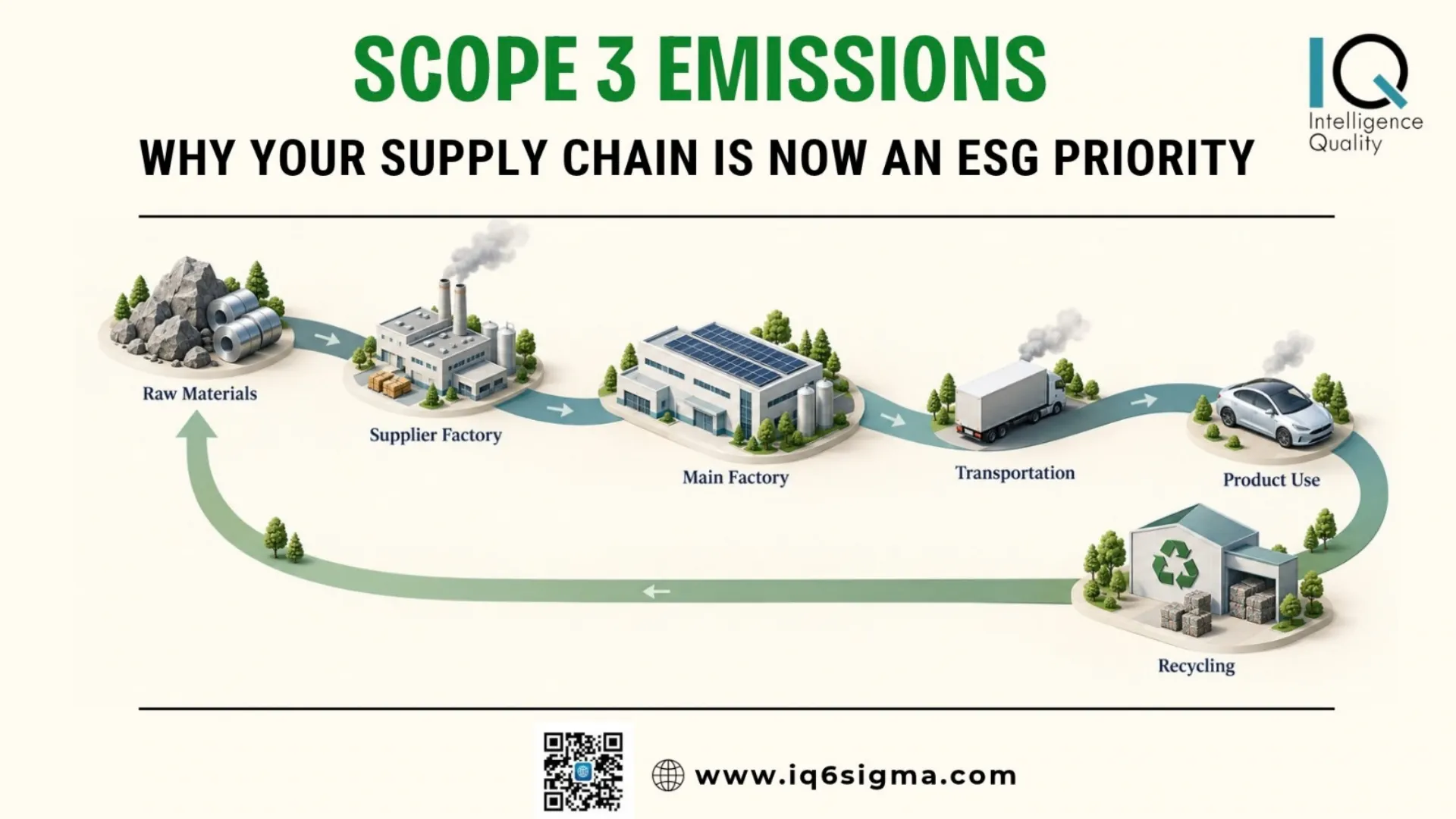
The biggest ESG challenge for many companies may not be inside their own factories, offices or facilities. It may be sitting with their suppliers. For years, businesses have focused on the emissions they can see and directly control. The fuel used in company vehicles. The gas consumed in production. The electricity purchased for offices and factories. These are important.
But increasingly, sustainability conversations are moving beyond the boundaries of the organization itself.
What happens before a raw material reaches your factory?
How is it transported?
What happens when your product leaves your facility?
How much energy is consumed when customers use it?
And what happens to that product at the end of its life?
These questions bring us to Scope 3 emissions - emissions associated with activities across a company's upstream and downstream value chain.
The GHG Protocol classifies Scope 3 as indirect greenhouse gas emissions occurring across the company's value chain and divides them into 15 categories, covering both upstream and downstream activities.
And this is where ESG becomes much more than a reporting exercise.
Imagine a manufacturing company producing automotive components. Inside the factory, the organization may have invested heavily in energy-efficient equipment, renewable electricity and waste reduction. Its direct emissions may be carefully monitored. But the story doesn't begin when the raw material arrives at the factory gate.
The steel, aluminium, plastics or chemicals used in production have already generated emissions during extraction, processing and transportation. The components may then be transported to customers. The finished vehicle may consume fuel or electricity during its use. Eventually, the product may require recycling or disposal.
Much of this activity falls outside the company's direct operational control. Yet it is connected to the company's business.
That is the fundamental challenge of Scope 3.
The GHG Protocol describes Scope 3 as including indirect emissions from both upstream and downstream activities, while Scope 1 covers direct emissions and Scope 2 covers emissions associated with purchased energy.
Scope 1: What your company directly emits.
Scope 2: Emissions associated with the energy your company purchases.
Scope 3: Emissions connected to the wider value chain around your business.
This makes Scope 3 particularly important for organizations that depend heavily on complex supply chains.
For many businesses, the supply chain is where the sustainability conversation becomes complicated. A company may have hundreds or thousands of suppliers. Each supplier may have different production processes, energy sources, transportation arrangements, data systems and sustainability practices.
Getting reliable emissions information from that ecosystem is not always straightforward.
A procurement team may know:
But it may not know:
This is why Scope 3 is not simply an environmental department's responsibility. It can involve procurement, supply chain, operations, finance, quality, logistics, engineering, sustainability and senior management.
The GHG Protocol specifically positions Scope 3 accounting as a way to understand value-chain emissions and identify where reduction activities can be focused.
The Scope 3 framework contains 15 categories.
Not every category will be material or relevant to every organization. The framework is intended to help companies systematically identify and assess emissions throughout their value chain.
For a manufacturer, for example, purchased goods and services and upstream transportation may deserve significant attention.
For a technology company, purchased services, business travel, employee commuting or the use of sold products may have greater relevance.
The starting point is therefore not to measure everything blindly. It is to understand where the material emissions are likely to be.
Here is where many organizations encounter their first major challenge.
You cannot manage what you cannot reasonably measure.
And you cannot build credible Scope 3 information simply by asking suppliers, "What are your carbon emissions?"
Different suppliers may use different calculation methods. Some may have primary data. Others may rely on estimates or industry averages. Some may not have measured their emissions at all.
That creates a familiar business problem:
Garbage in, garbage out.
If the underlying information is weak, the resulting ESG metrics can also be weak.
This is why Scope 3 should increasingly be viewed as a data-quality and process-management challenge, not just a sustainability challenge.
Organizations need to establish:
The GHG Protocol provides category-specific guidance and recognizes different approaches to calculating Scope 3 emissions.
Traditionally, procurement conversations have revolved around cost, quality, delivery and service. ESG is adding another dimension.
A supplier's environmental performance can increasingly become part of the broader business conversation. But this does not necessarily mean simply dropping suppliers that cannot immediately provide perfect emissions data.
A more practical approach can be to build supplier capability.
For example:
Identify major suppliers, materials, services, transportation routes and downstream activities.
Determine which Scope 3 categories are most relevant to the organization.
Define what information suppliers need to provide and in what format.
Help suppliers understand measurement methodologies and expectations.
Use the collected information to identify areas where emissions are concentrated.
Explore alternatives such as material efficiency, renewable energy, logistics optimization, supplier improvements and product redesign.
Turn sustainability objectives into measurable performance indicators.
This changes the conversation from:
"Give us your ESG data."
to:
"Let's understand the emissions in our value chain and identify where we can improve together."
That is a much more constructive way to approach supply-chain sustainability.
There is another side to Scope 3 that businesses sometimes overlook. Reducing emissions can also reveal opportunities to improve operational efficiency.
Consider transportation.
A company examining its Scope 3 emissions may discover that materials are travelling unnecessarily long distances, shipments are poorly consolidated, trucks are returning empty, or logistics routes are inefficient.
The ESG exercise may then uncover a business improvement opportunity.
The same can happen with:
Material consumption → Less waste → Lower cost
Energy-intensive suppliers → Supplier improvement → Lower environmental impact
Excess packaging → Packaging redesign → Less material and lower logistics cost
Product redesign → Lower energy consumption during use → Better customer value
This is why ESG should not always be treated as an additional reporting burden. Done thoughtfully, it can become another lens through which organizations examine cost, risk, efficiency and resilience.
The biggest mistake is trying to solve the entire Scope 3 problem at once.
Start with visibility.
Ask five basic questions:
1. Where does our value chain begin and end?
2. Which Scope 3 categories are relevant to our business?
3. Where do we have reliable data, and where are the gaps?
4. Which suppliers, materials, products or activities are likely to be major emission hotspots?
5. Which improvements can deliver measurable environmental and business value?
These questions create a practical starting point. From there, organizations can progressively strengthen their data, methodologies, supplier engagement and reduction strategies.
As ESG moves deeper into business operations, organizations need people who understand more than sustainability terminology.
They need professionals who can connect:
ESG + Data + Operations + Supply Chain + Risk + Business Strategy
This is one reason structured ESG learning is becoming increasingly relevant for professionals across functions.
An ESG Online Course can help professionals understand the frameworks, terminology, reporting concepts and implementation approaches needed to participate meaningfully in sustainability initiatives.
But the real value comes when that knowledge is taken beyond the classroom and applied to actual business processes.
For professionals working in procurement, operations, quality, supply chain, finance, HR or sustainability, this kind of structured learning can provide a foundation for understanding how environmental and social considerations increasingly intersect with business decisions.
And for organizations building internal ESG capability, it can be part of a broader learning strategy - helping teams develop a common understanding before moving into organization-specific implementation.