

In the relentless pursuit of efficiency, organizations have long relied on structured methodologies, deterministic models, and human intuition to optimize processes. From assembly lines to service workflows, the goal has remained constant: eliminate waste, balance workloads, and achieve seamless flow.
Yet, in an era defined by volatility, complexity, and real-time decision-making, static optimization models are reaching their limits.
Enter Reinforcement Learning (RL) - a branch of artificial intelligence that doesn’t just analyze processes but learns, adapts, and continuously improves them. This is not incremental optimization. This is the dawn of autonomous process intelligence.
Traditional process optimization - whether through Lean, Six Sigma, or operations research, relies heavily on predefined rules and historical data. While effective, these approaches assume stability.
But modern operations are anything but stable.
Demand fluctuates unpredictably. Supply chains face disruptions. Human variability impacts cycle times. Machines degrade over time.
Reinforcement Learning thrives in this uncertainty.
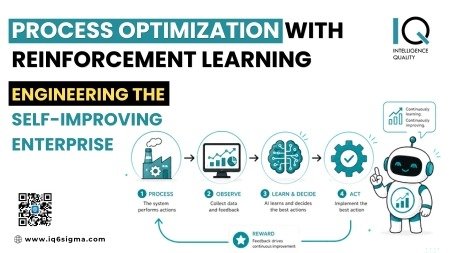
Instead of relying on fixed rules, RL systems interact with the environment, make decisions, observe outcomes, and refine their strategies dynamically. Over time, they discover optimal pathways that even experienced practitioners might overlook.
The result? Processes that don’t just operate efficiently - they evolve continuously.
Imagine a production line where workflows are not hardcoded but fluid, constantly adjusting based on real-time conditions.
Reinforcement Learning enables:
Every decision the system makes is guided by a reward function - minimizing delays, maximizing throughput, reducing cost, or balancing multiple objectives simultaneously.
This transforms workflows into living systems - capable of self-correction and self-optimization.
Takt time - the heartbeat of Lean operations, has traditionally been calculated based on average demand and static assumptions. But in reality, demand fluctuates, and process variability is inevitable.
Reinforcement Learning introduces a new paradigm: adaptive takt time balancing.
Instead of forcing operations to adhere to a fixed takt time, RL systems:
The outcome is a perfectly orchestrated flow where variability is not resisted - it is absorbed and optimized.
A common misconception is that AI replaces human expertise. In reality, Reinforcement Learning amplifies it.
Operators and process engineers bring contextual understanding, while RL systems bring computational intelligence and speed.
Together, they create a hybrid decision-making ecosystem:
This collaboration ensures that optimization is both intelligent and practical, grounded in real-world constraints.
One of the most powerful enablers of RL-driven optimization is the concept of digital twins - virtual replicas of physical systems.
Before deploying changes in the real world, RL models are trained in simulated environments where they can:
By the time strategies are implemented on the shop floor, they are already optimized, validated, and risk-mitigated. This dramatically accelerates innovation cycles while reducing operational risk.
Lean philosophy has long championed Kaizen - continuous improvement driven by human effort. Reinforcement Learning takes this principle to its logical extreme.
Improvement becomes:
Processes no longer wait for improvement initiatives. They improve themselves - every second, every cycle, every transaction.
For forward-looking leaders, the implications extend far beyond operational gains.
Reinforcement Learning unlocks:
More importantly, it redefines how organizations think about performance - not as a fixed target, but as a moving frontier.
As RL continues to mature, the vision ahead is both compelling and inevitable.
Picture an enterprise where:
In this future, process optimization is no longer a function - it is an embedded capability.
Reinforcement Learning is not just a technological upgrade - it is a strategic inflection point.
Organizations that embrace RL-driven process optimization will move beyond efficiency into true operational intelligence. They will build systems that learn faster than competitors, adapt quicker than disruptions, and deliver value with unprecedented precision.
For leaders, the message is clear:
The era of managing processes is ending.
The era of teaching systems to optimize themselves has begun.