

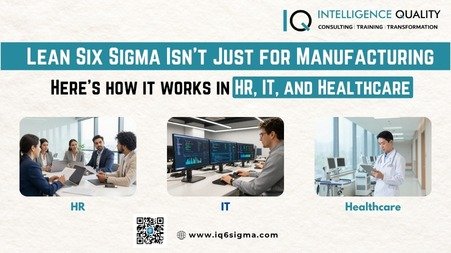
For decades, Lean Six Sigma has been synonymous with manufacturing excellence, assembly lines running like clockwork, defects approaching zero, and processes engineered for precision. It built its reputation on factory floors, where efficiency and quality directly translated into competitive advantage.
But here’s the reality modern leaders are waking up to:
Lean Six Sigma is not about machines. It’s about processes.
And wherever there is a process, whether hiring talent, resolving IT tickets, or treating patients: there is an opportunity to eliminate waste, reduce variation, and improve outcomes.
Today, Lean Six Sigma is quietly transforming functions far beyond manufacturing, becoming a strategic enabler across HR, IT, and Healthcare.
At its core, Lean Six Sigma combines two powerful philosophies:
These principles are universal. The only thing that changes is the environment in which they are applied.
Instead of production defects, we deal with hiring delays.
Instead of machine downtime, we face system outages.
Instead of scrap, we encounter rework, errors, and inefficiencies in decision-making.
The language changes - but the problems remain strikingly similar.
HR is often seen as a people-centric function, but it is also deeply process-driven. From recruitment to onboarding to performance management, inefficiencies in HR processes directly impact organizational performance.
Lean Six Sigma brings structure and clarity to HR operations.
HR evolves from an administrative function into a strategic driver of employee experience and organizational effectiveness.
IT departments are the backbone of modern enterprises, yet many operate in reactive mode, constantly resolving issues, managing tickets, and dealing with system inefficiencies.
Lean Six Sigma introduces discipline and predictability into IT operations.
IT shifts from a reactive support function to a proactive enabler of business continuity and innovation.
Few sectors benefit more from Lean Six Sigma than healthcare. Here, inefficiencies don’t just cost money, they impact patient lives.
Hospitals and healthcare systems are complex environments with multiple interdependent processes. Variability and delays can lead to serious consequences.
Lean Six Sigma brings order to this complexity.
Healthcare delivery becomes safer, faster, and more patient-centric, while also improving operational efficiency.
What connects HR, IT, and Healthcare is not their function, it’s their dependence on processes.
Lean Six Sigma introduces a mindset shift:
It encourages teams to ask fundamental questions:
This mindset is what drives transformation.
One of the biggest misconceptions about Lean Six Sigma is that it is overly technical or statistical.
In reality, its strength lies in simplicity:
These tools are accessible, adaptable, and highly effective across functions.
Organizations that extend Lean Six Sigma beyond manufacturing unlock a powerful advantage:
It creates a culture where improvement is not a project - it is a way of working.
As organizations embrace digital transformation, Lean Six Sigma is evolving alongside it. Combined with AI and analytics, it enables:
The future enterprise will not just run processes - it will optimize them continuously.
Lean Six Sigma was born in manufacturing, but it was never meant to stay there. Its principles are universal, its tools are adaptable, and its impact is transformative.
For leaders willing to look beyond traditional boundaries, Lean Six Sigma offers a clear path:
And ultimately, to an organization where every process, no matter where it exists, is designed to deliver maximum value with minimum waste.