

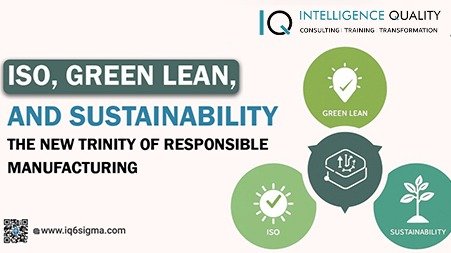
In the age of climate change, resource scarcity, and rising stakeholder expectations, manufacturing excellence is no longer defined by output alone. Organizations are now challenged to answer a bigger question:
Can we produce more, with less impact on the planet?
The answer lies in the powerful alignment of ISO Standards, Green Lean principles, and Sustainability practices; a framework that drives efficiency, compliance, and environmental responsibility together.
For decades, ISO (International Organization for Standardization) has set global benchmarks for quality, safety, and efficiency.
By integrating these standards, organizations build a robust foundation for sustainable operations, balancing profit, people, and planet.
While ISO sets the structure, Lean and Green principles provide the action. Lean Manufacturing eliminates the 8 types of waste (defects, overproduction, waiting, non-utilized talent, transportation, inventory, motion, and extra-processing), while Green Manufacturing focuses on minimizing environmental waste - energy, emissions, water, and raw materials.
Together, they form Green Lean - a strategic approach that:
For example, applying Lean tools like Value Stream Mapping (VSM) or Kaizen with an environmental lens helps teams visualize both material and energy waste, making sustainability measurable and actionable.
Sustainability is no longer optional; it’s a business imperative. Customers, investors, and regulators now expect transparency in Environmental, Social, and Governance (ESG) performance.
Companies that integrate ISO management systems with Lean Six Sigma and Green Manufacturing initiatives gain a triple advantage:
This holistic model is what modern manufacturing leaders call Sustainable Operational Excellence - the next step beyond traditional quality management.
A global electronics manufacturer integrated ISO 14001 and Lean Six Sigma to address energy inefficiency in its assembly process. Through DMAIC and Green Lean practices, the team reduced power usage by 22%, cut rework by 15%, and achieved ISO 50001 certification within a year.
The result was a sustainable competitive edge - efficiency gains aligned with environmental goals.
As industries move toward carbon neutrality and circular economy goals, ISO standards and Lean principles will continue to evolve hand-in-hand with sustainability. Organizations that embrace this synergy will not only meet compliance standards but lead the transformation toward eco-efficient excellence.