

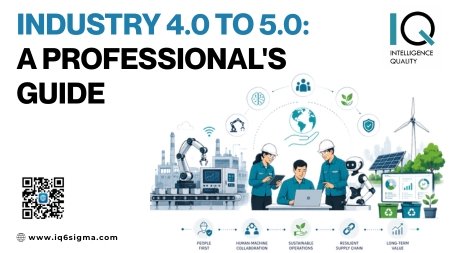
For more than a decade, Industry 4.0 has transformed manufacturing and business operations through digitalisation, automation, and connectivity.
Smart factories, Industrial Internet of Things (IIoT), cloud computing, artificial intelligence, digital twins, and advanced analytics have reshaped how organisations operate.
Yet, as technology adoption accelerates, a critical question has emerged:
Can digital transformation alone create sustainable business value?
The answer is driving the transition toward Industry 5.0.
Unlike its predecessor, Industry 5.0 does not focus solely on technology. It places people, sustainability, and resilience at the centre of industrial transformation.
For professionals and organisations alike, understanding this shift is no longer optional - it is essential for remaining competitive in an increasingly dynamic business environment.
Technology should empower people rather than replace them.
Industry 5.0 emphasises:
Collaborative robots, augmented reality, and AI assistants will increasingly support employees in complex decision-making.
The workforce of the future will combine technical expertise with creativity, critical thinking, and problem-solving skills.
Sustainability is becoming a core business requirement.
Industry 5.0 organisations focus on:
Environmental performance is now directly linked to profitability, investor confidence, and long-term competitiveness.
Frameworks such as ESG, BRSR, carbon accounting, and lifecycle assessment are becoming essential business capabilities.
Recent disruptions have highlighted the need for adaptable organisations.
Industry 5.0 prioritises:
Resilient organisations can anticipate, absorb, and recover from disruptions more effectively.
Although Industry 5.0 is human-centric, technology remains a critical enabler.
Key technologies include:
The difference lies in how these technologies are applied. The objective is no longer automation for automation's sake. The objective is creating sustainable, resilient, and human-centred value.
Traditional job descriptions will continue to evolve.
Professionals will increasingly work alongside intelligent systems, requiring interdisciplinary skills.
Future roles may include:
Technical expertise alone will not be enough.
Professionals must develop a blend of:
The future belongs to professionals who can integrate technology, process excellence, and sustainability.
Professionals preparing for Industry 5.0 should consider building expertise in the following areas:
Continuous learning will become one of the strongest competitive advantages in the modern workplace.
The organisations that thrive in this new era will combine advanced technologies with skilled people, sustainable practices, and resilient systems.
The transition from Industry 4.0 to Industry 5.0 has already begun. The question is not whether change is coming.
The question is whether organisations and professionals are prepared to lead it.