

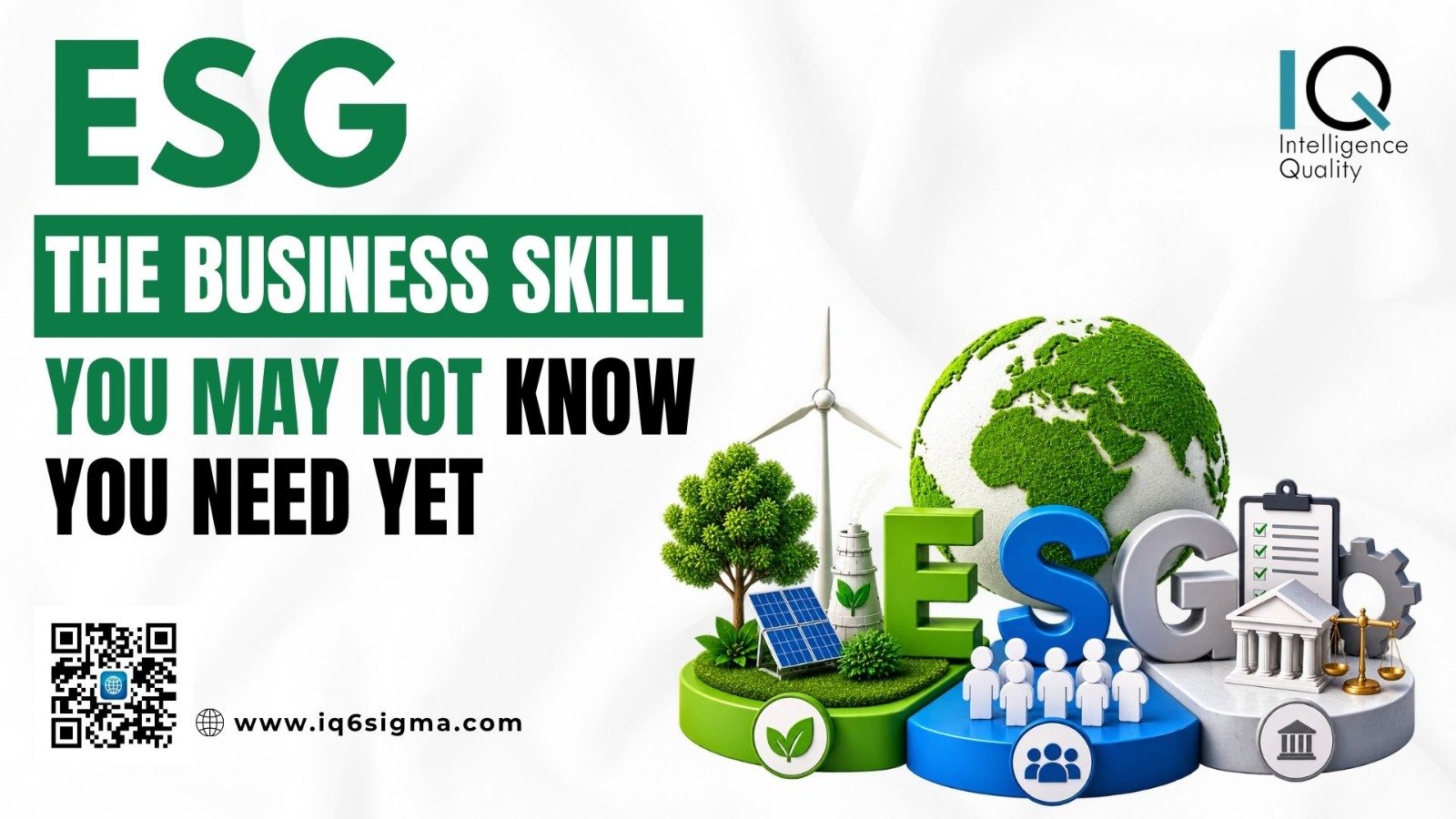
You have probably seen the word ESG everywhere, but if someone asked you today:
“What does ESG actually mean for a business?” Could you explain it confidently?
Many professionals know that ESG stands for Environmental, Social and Governance. Far fewer understand how it connects with their everyday work, and that is becoming a problem.
ESG is moving beyond sustainability reports and entering the way companies measure performance, manage risk, work with suppliers and make business decisions.
The easiest way to understand ESG is to look at the three parts.
E – Environmental
How does a company impact the environment?
Think energy, emissions, water, waste, pollution and resource efficiency.
S – Social
How does a company treat people?
Think employee safety, working conditions, human rights, employee development, communities and responsible supply chains.
G – Governance
How is the company managed?
Think ethics, transparency, compliance, accountability, risk management and responsible decision-making.
Put together, ESG asks a simple question:
“Are we running the business responsibly and sustainably?” Why Should Indian Businesses Care? Because ESG is becoming increasingly connected with corporate reporting and business expectations.
SEBI's BRSR framework requires the top 1,000 listed entities by market capitalization to make sustainability disclosures, while BRSR Core provides a focused set of ESG metrics. SEBI has also introduced industry standards for BRSR Core reporting. And the conversation is not limited to large listed companies.
Consider a manufacturer supplying a major corporate customer.
The customer may increasingly want information about:
Suddenly, ESG is no longer something happening in a boardroom. It reaches the supply chain.
This is where many organizations struggle. It is easy to say: “We are sustainable.” It is much harder to prove it. How much energy did you consume? How much waste did you generate? What were your emissions? How many workplace incidents occurred? How much training did employees receive? What percentage of suppliers were evaluated? Who owns this data? Can it be verified?
ESG therefore requires more than policies.
It requires processes, data, people, measurement and accountability. That is why ESG knowledge is becoming relevant to professionals across functions. You Don't Need an “ESG” Job Title
You may be working in:
Quality.
EHS.
HR.
Finance.
Procurement.
Operations.
Compliance.
Risk.
Management.
You may still be involved in ESG. A Quality professional may work on ESG-related processes and data. An EHS professional already deals with environmental and safety performance. HR connects directly with the social dimension. Procurement can influence responsible sourcing. Management needs to understand ESG risks and opportunities. ESG is becoming a cross-functional business skill.
Understand:
ESG principles – What ESG really means.
Materiality – Which ESG issues matter most to the business and its stakeholders.
ESG metrics – What should actually be measured.
BRSR and reporting – How ESG information is structured and communicated.
ESG risks – How environmental, social and governance issues can affect business performance.
Implementation – How an organization moves from an ESG policy to measurable action.
A structured certification can help bring these areas together instead of learning ESG through disconnected articles, webinars and social media posts.
The biggest opportunity in ESG isn't simply producing another report. It is building people who understand how sustainability connects with business performance.
Companies will need professionals who can ask better questions:
What should we measure? Where does the data come from?What are our biggest ESG risks? Who is responsible? How do we improve our performance? And perhaps the most important question:
How do we turn ESG from a reporting exercise into a business improvement opportunity? You don't have to change your career to enter the ESG space.
Sometimes, you simply need to add a new skill to the career you already have. Start with understanding. Build with certification. Apply it to your business.
ESG is no longer just a sustainability conversation. It is becoming a business conversation.
use this article a create a related image white background is be needed could be create
You have probably seen the word ESG everywhere, but if someone asked you today:
“What does ESG actually mean for a business?” Could you explain it confidently?
Many professionals know that ESG stands for Environmental, Social and Governance. Far fewer understand how it connects with their everyday work, and that is becoming a problem.
ESG is moving beyond sustainability reports and entering the way companies measure performance, manage risk, work with suppliers and make business decisions.
The easiest way to understand ESG is to look at the three parts.
E – Environmental
How does a company impact the environment?
Think energy, emissions, water, waste, pollution and resource efficiency.
S – Social
How does a company treat people?
Think employee safety, working conditions, human rights, employee development, communities and responsible supply chains.
G – Governance
How is the company managed?
Think ethics, transparency, compliance, accountability, risk management and responsible decision-making.
Put together, ESG asks a simple question:
“Are we running the business responsibly and sustainably?” Why Should Indian Businesses Care? Because ESG is becoming increasingly connected with corporate reporting and business expectations.
SEBI's BRSR framework requires the top 1,000 listed entities by market capitalization to make sustainability disclosures, while BRSR Core provides a focused set of ESG metrics. SEBI has also introduced industry standards for BRSR Core reporting. And the conversation is not limited to large listed companies.
Consider a manufacturer supplying a major corporate customer.
The customer may increasingly want information about:
Suddenly, ESG is no longer something happening in a boardroom. It reaches the supply chain.
This is where many organizations struggle. It is easy to say: “We are sustainable.” It is much harder to prove it. How much energy did you consume? How much waste did you generate? What were your emissions? How many workplace incidents occurred? How much training did employees receive? What percentage of suppliers were evaluated? Who owns this data? Can it be verified?
ESG therefore requires more than policies.
It requires processes, data, people, measurement and accountability. That is why ESG knowledge is becoming relevant to professionals across functions. You Don't Need an “ESG” Job Title
You may be working in:
Quality.
EHS.
HR.
Finance.
Procurement.
Operations.
Compliance.
Risk.
Management.
You may still be involved in ESG. A Quality professional may work on ESG-related processes and data. An EHS professional already deals with environmental and safety performance. HR connects directly with the social dimension. Procurement can influence responsible sourcing. Management needs to understand ESG risks and opportunities. ESG is becoming a cross-functional business skill.
Understand:
ESG principles – What ESG really means.
Materiality – Which ESG issues matter most to the business and its stakeholders.
ESG metrics – What should actually be measured.
BRSR and reporting – How ESG information is structured and communicated.
ESG risks – How environmental, social and governance issues can affect business performance.
Implementation – How an organization moves from an ESG policy to measurable action.
A structured certification can help bring these areas together instead of learning ESG through disconnected articles, webinars and social media posts.
The biggest opportunity in ESG isn't simply producing another report. It is building people who understand how sustainability connects with business performance.
Companies will need professionals who can ask better questions:
What should we measure? Where does the data come from? What are our biggest ESG risks? Who is responsible? How do we improve our performance? And perhaps the most important question:
How do we turn ESG from a reporting exercise into a business improvement opportunity? You don't have to change your career to enter the ESG space.
Sometimes, you simply need to add a new skill to the career you already have. Start with understanding. Build with certification. Apply it to your business.
ESG is no longer just a sustainability conversation. It is becoming a business conversation.