

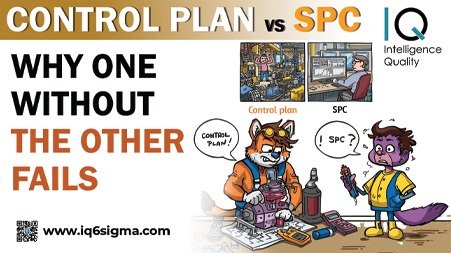
In modern manufacturing, quality is no longer an afterthought - it is a competitive differentiator. Tools like Control Plans and Statistical Process Control (SPC) are widely used, but a common misconception persists: that either can fully ensure process quality on its own. In practice, using one without the other often leads to failure, inefficiency, or false confidence.
A Control Plan is a structured document outlining how a process will be monitored, controlled, and maintained to ensure consistent quality. It specifies process steps, control methods, measurement criteria, and reaction plans for deviations.
Purpose: To standardize processes and ensure every operator knows what to monitor and how.
Example: In an automotive assembly line, the control plan might specify torque settings for bolts, measurement intervals for hole diameters, and inspection methods for surface finish.
Statistical Process Control (SPC) uses statistical methods to monitor and control a process over time. It distinguishes between common-cause variation, which is inherent in the process, and special-cause variation, which arises from specific events.
SPC uses tools like control charts, capability analysis, and trend monitoring to detect early signs of deviation, allowing proactive interventions.
Example: A paint spray booth may use SPC charts to track coating thickness across shifts. Early warning signals prevent out-of-spec batches even if the control plan is followed.
While a control plan defines what should be done, it cannot detect process drift or subtle variation. Operators may follow instructions perfectly but fail to notice gradual deviations that eventually produce defects. Without SPC, compliance with the control plan can create a false sense of security.
Case in point: A factory following a control plan for machine calibration may still produce out-of-spec parts if tool wear develops gradually - SPC would detect this trend before defects appear.
SPC identifies variation but does not define what to measure, how often, or how to respond. Without a control plan, monitoring can be inconsistent and reactive. Alerts from control charts may occur, but without structured reaction steps, the response can be delayed or inappropriate.
Case in point: A control chart flags a spike in CNC machine vibration. Without a control plan detailing inspection frequency and corrective action, production may continue until a part fails.
Control plans and SPC are complementary. The control plan defines critical process steps and actions, while SPC monitors variation in real time. Together, they create a system that is both standardized and adaptive.
Example in practice: The control plan requires torque checks every 50 units, with an acceptable range of 20±1 Nm. SPC charts monitor torque readings continuously, alerting operators when trends approach the limits. Maintenance can then be scheduled proactively, preventing defective parts.
Modern factories integrate control plans and SPC digitally. Smart sensors feed real-time SPC dashboards, which are linked to the reaction steps outlined in the control plan. Analytics refine both the plan and SPC parameters, ensuring processes remain stable, predictable, and continuously improving.
In practical manufacturing, quality is not achieved by choosing between control plans and SPC - it comes from using both synergistically. Without this integration, factories risk costly defects, rework, and loss of customer trust.