

Images

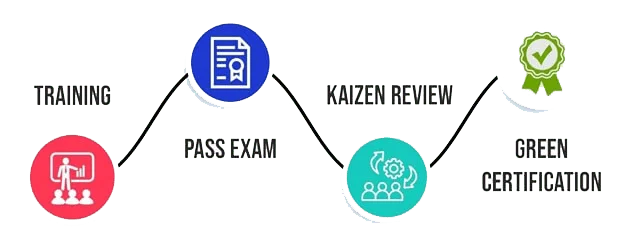
Lean Six Sigma Green Belt

The Green Belt is the second level of Six Sigma, ideal for those seeking deeper expertise in process optimization. Green Belts work under Black Belts, solving business problems, eliminating inefficiencies, and implementing creative solutions for streamlined workflows.
Who should attend?
  • Professionals in operations, quality, logistics, finance, production, and engineering.
  • Process owners or team leaders.
  • Individuals with technical expertise and project experience.
Define
  • Quality Overview
  • Customer’s Role in Business, Six Sigma Overview
  • Mapping the process – SIPOC
  • Project Charter
Measure
  • Data Collection, Operational Definition
  • Measurement System Analysis
  • Control Charts
  • Histogram for Process Normality
  • Process Capability Indices
Analyse
  • Root Cause Analysis, Why-Why Analysis
  • FMEA
  • Hypothesis Testing
  • Scatter Diagram
  • Correlation & Regression
  • Pareto Diagram, Stratification
Improve
  • Waste Identification
  • 5 S for workplace organization
  • DOE Overview
  • Poka Yoke
Control
  • Project Handing Over
  • Control charts interpretation
  • Control Plan
  • ✔ Lead and manage process improvement projects
  • ✔ Collect and analyze process data
  • ✔ Create process maps for better workflow understanding
  • ✔ Apply problem-solving and Lean Six Sigma techniques
  • ✔ Identify and eliminate waste and defects
  • ✔ Implement Six Sigma methodology with confidence
  • ✔ Work closely with process owners to sustain improvements

Enroll for Individual / Corporate Training

Lean Six Sigma Black Belt

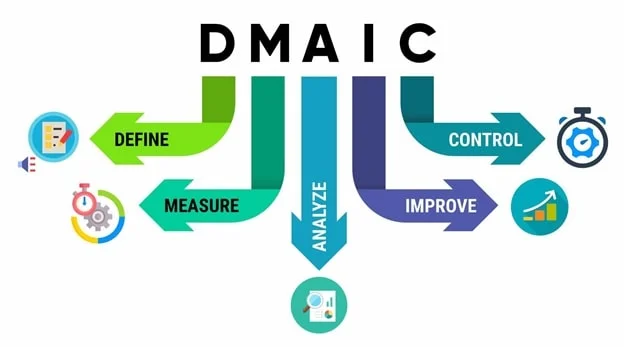
The Black Belt program equips professionals to lead core process teams and mentor others in Six Sigma concepts, tools, and software. Certified Black Belts gain deep expertise in the DMAIC model and hands-on project experience.
Who should attend?
  • Professionals seeking a structured approach to problem-solving.
  • Individuals aiming to enhance organizational performance.
  • Process improvement team members leading projects.
  • Management professionals driving positive change.
  • Those looking to develop domain-independent expertise.
Define
  • Quality Overview
  • Quality Function Deployment
  • Tree diagram, Prioritization matrix
  • Key financial metrics calculation
  • Project Charter
  • Mapping the process – SIPOC
Measure
  • Data Collection, Operational Definition
  • Control Charts for Process Stability
  • Process Capability Indices
  • Gage R&R – Xbar & R, ANOVA method
  • Attribute Agreement analysis
  • DPMO, RTY
Analyse
  • Root Cause Analysis, Why-Why Analysis
  • FMEA
  • Hypothesis Testing
  • Scatter Diagram
  • Correlation & Regression
  • Hypothesis Testing – Z test, F test, Chi square test, ANOVA
  • Lean concepts, Kaizen, Value stream mapping
Improve & Control
  • Waste Identification
  • DOE, Full factorial, Fractional factorial and Orthogonal array
  • Visual management system
  • Control chart interpretation
  • ✔ Define team roles and responsibilities
  • ✔ Plan and execute process improvement experiments
  • ✔ Apply statistical tools for data-driven decisions
  • ✔ Eliminate waste and errors in processes
  • ✔ Utilize Six Sigma tools for project definition, analysis, and control
  • ✔ Implement process controls to sustain improvements
  • ✔ Mentor teams on DMAIC methodology
  • ✔ Identify project selection criteria and develop proposals
  • ✔ Gain hands-on experience with Minitab

Enroll for Individual / Corporate Training

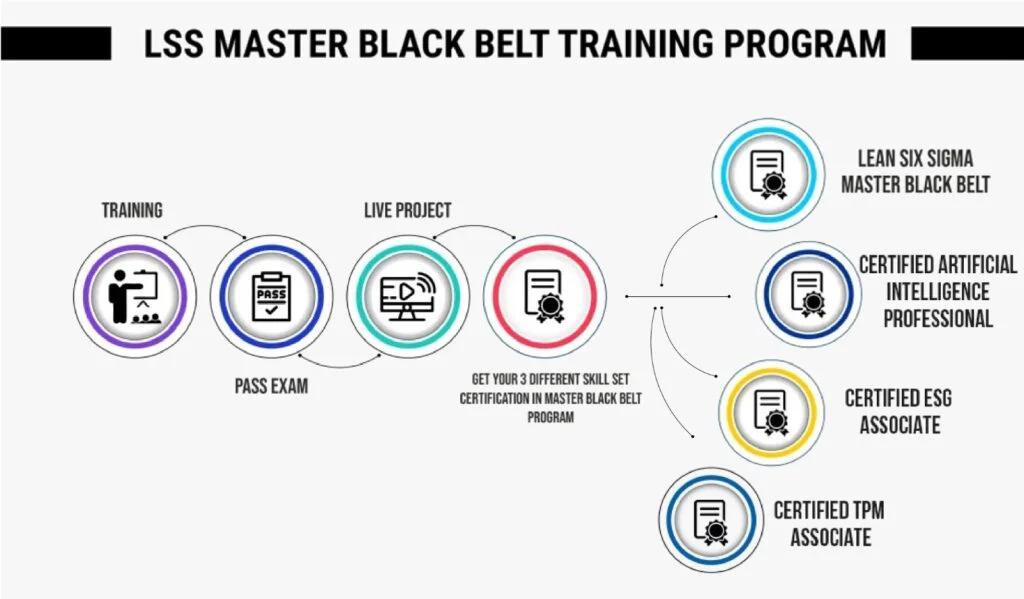
Lean Six Sigma Master Black Belt

Master Black Belts are responsible for training Black, Green, and Yellow Belts in Six Sigma methodologies and overseeing Six Sigma projects within the organization.
who should Attend?
  • Certified Black Belts seeking advanced problem-solving and leadership skills.
  • Professionals aspiring for Lean Six Sigma leadership roles.
  • Leaders aiming for MBB certification.
  • Individuals planning to become independent Lean Six Sigma trainers/coaches.
  • Quality professionals pursuing senior strategic roles.
Lean Six Sigma Advanced Master Tools
  • Business Excellence – Strategy towards Shareholder value creation
  • LSS Deployment Planning & Kick -off
  • Achieving CEO commitment towards Business Excellence
  • Design For Six Sigma Framework and TRIZ
Design Thinking & Agile Methodology
  • Integrating designer’s Mindset and customer’s Mindset
  • Design thinking for problem solving
  • Project Management Tools & Agile Methodology (information flow Processes)
  • Design thinking for problem solving
Data Visualization
  • New Age CI Levers: Industry 4.0 (RPA Automation/ Interconnected/Intelligence) IOT
  • Data Visualization – Data Studio & Power Bi
  • Leadership
    • Stability & Capability Exercise: Normal, Binomial, and Poisson distribution
    • Leadership Development, Remote Project Execution & Monitoring Framework
    • People Capability Building: Training Plan and Implementation. Mentoring and Coaching Framework
    Lean Master
    • Advanced lean tools- Sustainability VSM, Ergo VSM, Energy VSM
    • Architecture of Integrating Lean with Industry 4.0 concepts
    • Sustainability 7S
    • Integrating lean manufacturing paradigms with sustainability
    Data Analytics
    • Stability & Capability Exercise: Normal, Binomial, and Poisson distribution
    • Advanced Data Analytics: Predictive Statistics
    • Advanced Data Analytics: Descriptive and Inferential
    • Advanced Data Analytics: Design of Experiments. Response Optimizer
    • Advanced Data Analytics: Descriptive and Inferential
    • Data Science Simplified
  • ✔ Advanced problem-solving and decision-making techniques
  • ✔ Expertise in coaching and mentoring Six Sigma teams
  • ✔ Leadership in driving business excellence initiatives
  • ✔ Mastery of statistical and analytical tools
  • ✔ Strategic planning and process optimization
  • ✔ Implementation of high-impact improvement projects
  • ✔ Effective change management and stakeholder engagement

Enroll for Individual / Corporate Training

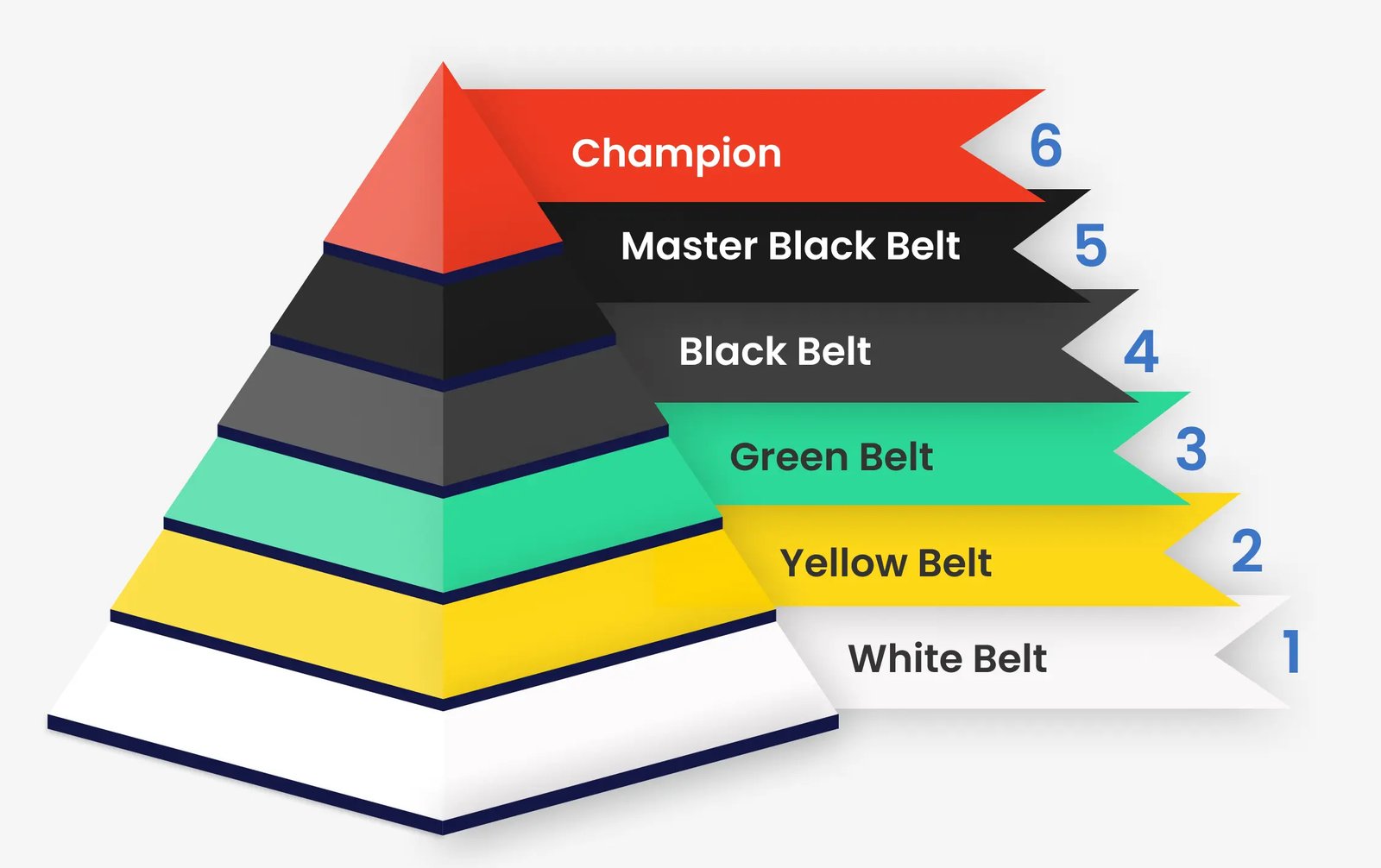
LSS CHAMPION

A Lean Six Sigma Champion is a senior leader who supports and drives continuous improvement initiatives within an organization. Champions ensure that improvement projects align with business goals, provide guidance and resources, remove barriers, and support Lean Six Sigma Black Belt and Lean Six Sigma Green Belt teams in executing projects effectively. Their role is to promote a culture of data-driven decision-making, operational excellence, and sustainable business improvement.
Who Should Attend?
  • Senior leaders and executives
  • Directors and department heads
  • Business unit leaders
  • Operations and functional managers
  • Sponsors of Lean Six Sigma initiatives
  • Leaders supporting Lean Six Sigma Black Belt and Lean Six Sigma Green Belt projects
  • LSS and its importance in your organization
  • Roles and responsibilities of LSS Champion
  • Resource and Development plans for LSS deployment
  • Characteristics of Green & Black Belts
  • Primary LSS tools
  • Managing changes in the organization
  • How to select and manage projects in an organization.

Enroll for Individual / Corporate Training

Sigma Chart Training Testimonial Testimonial