On this page
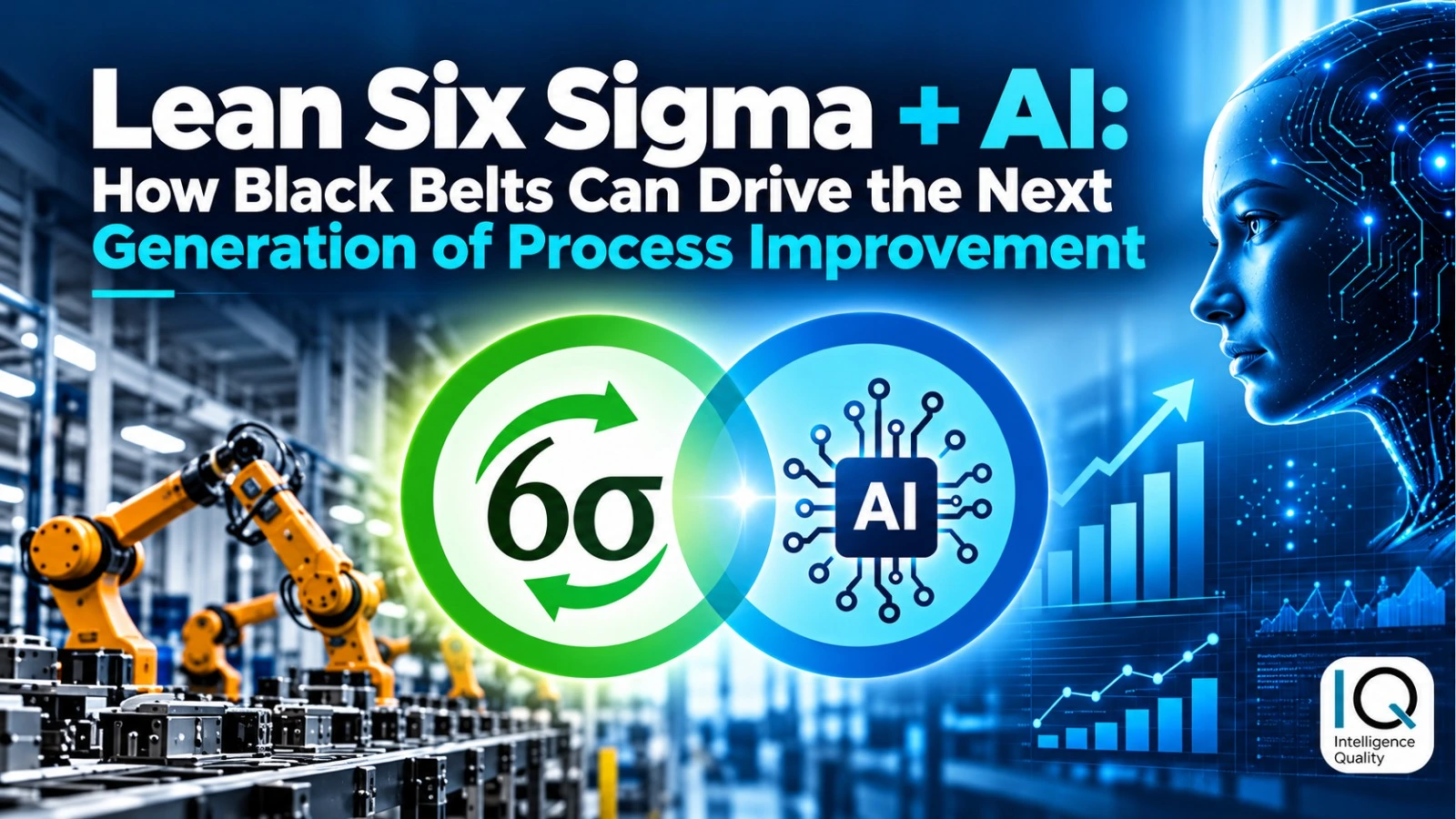
Lean Six Sigma has always been about one fundamental idea: use data to understand problems, remove waste and improve processes. Now, a new capability is changing how that work can be done.
Artificial Intelligence.
AI is increasingly helping organizations analyze large datasets, identify patterns, automate repetitive tasks and support faster decision-making. For Lean Six Sigma Black Belts, this does not replace the DMAIC methodology. Instead, it can add another layer of speed and analytical capability to an already structured improvement approach.
The future of process improvement may not be Lean Six Sigma versus AI. It may be Lean Six Sigma with AI.
Where AI Fits Into DMAIC
The strength of Lean Six Sigma comes from its structured approach.
Define → Measure → Analyze → Improve → Control
AI can complement each stage, but the Black Belt remains responsible for defining the business problem, validating evidence and making sound improvement decisions.
Define
AI tools can help teams analyze customer feedback, complaints, service tickets and operational information to identify recurring themes.
But technology cannot determine the right business problem on its own.
The Black Belt still needs to ask:
What problem are we actually trying to solve?
Measure
Modern processes generate enormous amounts of data.
AI and analytics can help process this information faster, identify unusual patterns and support real-time monitoring.
For example, manufacturing teams can analyze production, equipment and quality data to identify patterns that may not be immediately visible through manual analysis.
The important principle remains:
Better analysis begins with reliable data.
Analyze
This is where the combination becomes particularly powerful.
AI can identify correlations, trends and patterns across large datasets. It can help teams explore potential relationships between process variables and outcomes. But correlation is not automatically causation.
A Black Belt still needs to validate potential root causes using appropriate statistical methods, process knowledge and experimentation. AI can help identify where to look.
Six Sigma methodology helps determine whether the evidence is strong enough to act.
Improve
Once the root causes are validated, AI can support the evaluation of improvement options.
Depending on the process, organizations may use predictive models, simulations or optimization techniques to test possible scenarios before implementing changes.
This can help teams move from:
“We think this improvement will work.”
to:
“The available data indicates how this improvement may affect process performance.”
Control
Improvement is not complete when the solution is implemented. It has to be sustained.
AI-enabled monitoring can help identify unusual process behaviour and potential deviations earlier, supporting faster intervention.
Combined with control charts, process capability measures and established control plans, this can strengthen the Control phase.
What AI Cannot Replace
The growing use of AI does not make traditional Six Sigma skills irrelevant. In fact, it makes them more important.
Black Belts still need to understand:
- Process mapping
- Measurement System Analysis
- Statistical analysis
- Root-cause analysis
- Hypothesis testing
- Process capability
- Design of Experiments
- Control methods
Why?
Because AI can produce an answer that looks convincing without necessarily being correct.
A skilled Black Belt knows how to challenge the result.
- Where did the data come from?
- Is the measurement reliable?
- Is the relationship statistically meaningful?
- Could another variable explain the result?
- Has the improvement been validated?
These questions remain human responsibilities.
The New Black Belt Skill Set
The modern Black Belt is likely to work at the intersection of three capabilities:
Process Knowledge: Understanding how the process actually works.
Statistical Thinking: Using evidence to distinguish signals from noise.
Digital & AI Capability: Using modern technologies to analyze information and accelerate improvement.
This combination can make process improvement faster without sacrificing methodological discipline. For professionals pursuing six sigma certification, this broader skill set is increasingly relevant because organizations are combining traditional process improvement with analytics, automation and digital technologies. The goal is not to become an AI specialist instead of a Six Sigma practitioner.
It is to become a better problem solver with better tools.
A Practical Example
Consider a manufacturing process experiencing recurring defects.
A traditional DMAIC project might involve:
- Measure: Collect defects and process data.
- Analyze: Identify potential root causes.
- Validate: Use statistical analysis and process knowledge.
- Improve: Modify the process.
- Control: Monitor performance.
Now add AI.
An AI-enabled system could analyze historical production data, detect patterns across multiple variables and flag conditions associated with increased defect rates.
The Black Belt can then investigate those signals, validate the suspected causes and design an appropriate improvement. The technology accelerates the search. The methodology protects the decision.
What This Means for Organizations
Companies should not approach AI as a replacement for structured improvement methodologies. Instead, they can look for areas where AI can strengthen existing improvement systems.
Start with practical questions:
- Where are we spending too much time collecting or analyzing data?
- Which processes generate enough data for advanced analytics?
- Where could predictive monitoring prevent defects or failures?
- Which repetitive improvement activities could be automated?
These questions can identify realistic opportunities without turning every Six Sigma project into an AI project.
The Next Generation of Process Improvement
Lean Six Sigma gave organizations a disciplined way to solve problems. AI is giving them new ways to work with information.
Together, they can create a powerful combination:
Lean Six Sigma provides the structure. Data provides the evidence. AI provides additional analytical capability. Black Belts provide the judgment.
For professionals pursuing six sigma certification in Chennai, understanding this intersection can help prepare them for a workplace where process improvement increasingly involves data analytics, automation and intelligent technologies.
And for organizations, the opportunity is not simply to use more technology. It is to use technology with discipline.
Because the future of process improvement will not belong to the organization with the most AI tools.
It will belong to the teams that know which problem to solve, which data to trust and which improvement will actually make the process better.
That is where the modern Black Belt makes the difference.
Six Sigma + AI: smarter analysis, faster insight, better improvement.
For professionals looking to build this combined capability, six sigma black belt certification can provide the structured foundation on which modern digital improvement skills can be developed.