

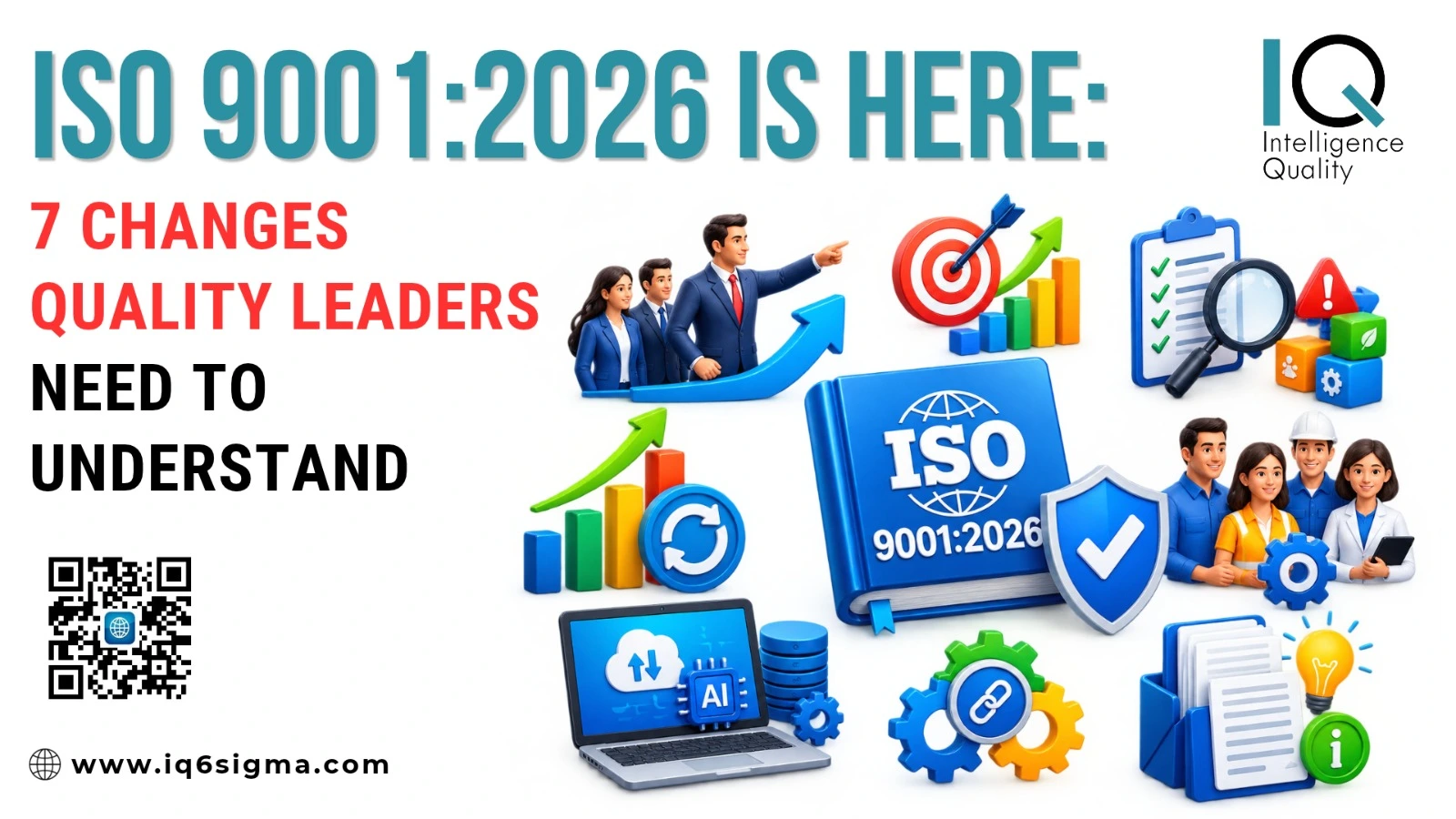
After more than a decade with ISO 9001:2015, the quality management standard has entered its next phase.
ISO 9001:2026 was officially published on 16 September 2026, replacing ISO 9001:2015. The new edition keeps the familiar foundation of quality management but introduces targeted changes to improve clarity, usability and relevance to today's business environment.
For organizations already certified to ISO 9001:2015, this is not a completely new quality management system. It is an opportunity to review what is already working, understand what has changed and strengthen the QMS where needed.
Here are seven key changes quality leaders should understand.
ISO 9001:2026 places greater emphasis on leadership, accountability and quality culture.
Quality is not simply the responsibility of the Quality Manager.
Top management is expected to create an environment where quality is embedded in the way the organization operates and where people understand their contribution to the QMS. ISO also highlights ethical behaviour as part of this stronger focus on quality culture.
Quality leaders should look beyond procedures and ask:
Is quality actually part of how decisions are made?
The revised standard strengthens the connection between the quality management system and the organization's strategic direction.
A QMS should not operate as a separate compliance system. Quality objectives, policies and processes should support what the organization is trying to achieve.
Business strategy → Quality objectives → Processes → Performance → Improvement
This makes the QMS more relevant to senior management and business performance.
ISO 9001:2026 provides greater clarity around risks and opportunities.
The revision distinguishes more clearly between managing risks and pursuing opportunities, encouraging organizations to consider both when making decisions and planning improvements.
The practical question for quality teams becomes:
What could prevent us from achieving our intended results, and where could improvement create a better result?
A QMS ultimately depends on people. The 2026 edition strengthens the emphasis on awareness, quality culture and ethical behaviour.
This means organizations need to consider whether employees understand:
Quality therefore becomes more than documentation. It becomes a shared organizational behaviour.
One of the notable additions is a new Annex A designed to clarify key terms and explain the intent behind requirements.
This is particularly useful because ISO 9001 is implemented across organizations of very different sizes, sectors and levels of QMS maturity. The objective is greater consistency in understanding and applying the standard.
ISO 9001:2026 adopts the latest Harmonized Structure used across ISO management system standards. This supports easier integration with other systems such as environmental, occupational health and safety, and information security management systems.
For organizations operating multiple ISO standards, this can help reduce duplication and make integrated management systems easier to structure.
ISO 9001:2026 recognizes the realities of modern, technology-enabled quality management, including the use of digital, automated and AI-enabled systems for managing documented information and QMS processes. The focus remains on ensuring that such information is controlled, accessible, reliable and suitable for its intended purpose.
Perhaps the most important point is what has not changed.
ISO 9001:2026 continues to build on the established principles of quality management, including:
The familiar QMS framework remains. The 2026 edition is therefore better understood as an evolution of ISO 9001, not a complete replacement of everything organizations already have in place.
Organizations currently certified to ISO 9001:2015 do not need to start from zero. The next step is to understand the differences, review the existing QMS and identify where changes are required.For professionals responsible for evaluating QMS compliance and preparing for transition audits, understanding the role of an ISO 9001 Lead Auditor can also be valuable.
ISO/TC 176's current transition guidance states that organizations certified to ISO 9001:2015 have until 30 September 2029 to complete their transition to ISO 9001:2026. From 31 March 2028, new and initial accredited certifications may only be issued to ISO 9001:2026.
A sensible transition approach can begin with:
1. Understand the revised requirements
2. Conduct a gap assessment
3. Review leadership and quality-culture practices
4. Revisit risks, opportunities and strategic alignment
5. Update relevant QMS processes and documented information
6. Train the people responsible for implementation and auditing
7. Prepare for the transition audit.
The real message behind the revision is simple. Quality management is moving further away from being viewed purely as a compliance activity.
A modern QMS should help an organization:
Deliver consistent results → Manage risks → Improve processes → Build customer confidence → Support business performance
That makes understanding the new standard important not only for Quality Managers and Auditors, but also for professionals involved in operations, manufacturing, supply chain, process improvement and management systems.
For professionals who need to understand the revised requirements and their practical application, ISO 9001 Training can provide a structured way to build that knowledge.
The transition to ISO 9001:2026 is not simply about changing documents. It is about asking a more important question:
Is your Quality Management System ready for the way your business operates today? With ISO 9001:2026 now officially published, the time to understand the changes is no longer in the future.
The new standard is here.
Discover how Artificial Intelligence enhances Lean Six Sigma and DMAIC methodology. Learn ...
Read More
Discover how ESG assurance verifies sustainability data, improves reporting accuracy, and ...
Read More
Understand Scope 3 emissions, why supply chain emissions matter for ESG, and how businesse...
Read More