

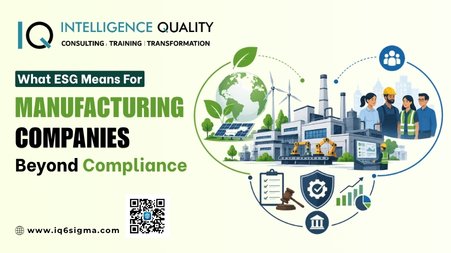
For many manufacturing companies, the term ESG still feels distant, corporate, or heavily associated with large multinational organizations. In boardrooms and industry discussions, Environmental, Social, and Governance initiatives are often presented through complex reports, sustainability frameworks, investor expectations, and global policy conversations.
As a result, many small and mid-sized manufacturers continue to view ESG as either a future concern, a compliance requirement, or an initiative relevant only to large corporations.
However, this perception is changing rapidly.
Across global supply chains, ESG is no longer being treated merely as a reporting exercise. Increasingly, it is becoming a reflection of how responsibly, efficiently, and sustainably an organization operates.
For manufacturing companies in particular, ESG is not simply about image or compliance. At its core, it is closely connected to operational discipline, resource efficiency, workforce practices, and long-term business resilience.
In many ways, manufacturers have already been practicing parts of ESG for years - often without calling it ESG.
ESG stands for Environmental, Social, and Governance. Together, these areas help evaluate how organizations manage their impact on the environment, employees, society, and internal systems of accountability.
While ESG frameworks can sometimes appear highly technical, the practical meaning for manufacturing businesses is much more straightforward.
It asks important operational questions:
How efficiently are resources being used?
How safely are employees working?
How responsibly are processes being managed?
How sustainable is the organization over the long term?
For manufacturers, ESG is gradually becoming less about external pressure and more about operational maturity.
The environmental component of ESG is often associated with climate change discussions and global sustainability goals. But inside manufacturing environments, it frequently begins with something much simpler: waste.
Manufacturing operations consume significant amounts of energy, water, raw materials, chemicals, packaging, and fuel. Whenever these resources are used inefficiently, both environmental impact and operational cost increase simultaneously.
This is one reason ESG aligns naturally with Lean Manufacturing principles.
Organizations that reduce defects, overproduction, excess inventory, waiting, transportation, and material waste are not only improving efficiency - they are also strengthening environmental performance.
In many factories, sustainability improvements do not begin with expensive technology investments. They begin with process awareness.
Simple operational improvements such as reducing compressed air leakage, optimizing machine utilization, minimizing scrap, improving preventive maintenance, and controlling energy consumption can create measurable environmental and financial benefits together.
Increasingly, customers and global supply chains are also paying attention to these practices. Manufacturers that demonstrate responsible resource management are often viewed as more reliable long-term partners.
The social dimension of ESG focuses on people.
In manufacturing environments, this extends far beyond employee welfare programs alone. It includes workplace safety, skill development, employee engagement, labor practices, operational culture, and overall working conditions.
Historically, many organizations measured manufacturing success primarily through production output. However, modern operational excellence increasingly recognizes that sustainable performance depends heavily on workforce stability and engagement.
Organizations with strong social practices often experience lower turnover, better productivity, improved morale, stronger teamwork, and fewer operational disruptions.
One of the most visible aspects of the social pillar is workplace safety.
A strong safety culture reflects more than compliance with regulations. It reflects process discipline and organizational responsibility.
Unsafe workplaces usually indicate deeper operational weaknesses such as inconsistent procedures, poor communication, inadequate training, or weak accountability systems.
Conversely, organizations that prioritize safety often demonstrate stronger operational control overall.
Training also plays a significant role within ESG.
As industries evolve, manufacturers increasingly require employees who can solve problems, understand processes, interpret data, and contribute to continuous improvement.
Organizations that invest in workforce capability are often better positioned to adapt to technological, operational, and market changes over time.
The governance component of ESG is sometimes the least visible but often the most influential.
Governance refers to how organizations are managed, controlled, and held accountable.
For manufacturing companies, this includes process discipline, ethical practices, compliance systems, risk management, leadership accountability, and decision-making structures.
Strong governance creates operational consistency.
It ensures that processes are followed, deviations are investigated, responsibilities are clear, and improvements are sustained systematically.
In many ways, governance is what prevents organizations from operating reactively.
Without disciplined governance systems, even technically strong operations can become unstable over time.
This is why ESG frequently intersects with:
Governance transforms improvement from isolated activities into repeatable organizational behavior.
Several years ago, ESG discussions were driven mainly by investors and large global enterprises. Today, the expectations are spreading throughout entire supply chains.
Customers increasingly want to know:
In some sectors, ESG performance is already influencing supplier evaluations, procurement decisions, export opportunities, and partnership selection.
At the same time, operational pressures are also increasing.
Manufacturers today face challenges such as rising energy costs, resource constraints, skilled workforce shortages, regulatory expectations, and growing customer demands for transparency.
ESG helps organizations respond to these pressures through more structured and sustainable operational thinking.
One of the biggest misconceptions about ESG is that it operates independently from manufacturing performance.
In reality, many ESG principles align closely with operational excellence methodologies that manufacturers already understand.
This overlap is important because it shows that ESG is not necessarily an entirely new system. Often, it is an extension of disciplined manufacturing practices already familiar to Lean and quality-driven organizations.
Perhaps the most important shift organizations must make is moving beyond viewing ESG purely as a compliance activity.
Compliance asks:
“What minimum requirements must we meet?”
Sustainability-oriented organizations ask:
“How do we build operations that remain efficient, responsible, and resilient over time?”
This mindset difference is significant.
When ESG becomes integrated into operational strategy rather than treated as an external obligation, organizations often discover broader benefits:
Manufacturing has always been built on efficiency, consistency, and process control.
ESG does not replace those principles.
Instead, it expands them.
It encourages organizations to think not only about production output, but also about long-term sustainability, responsible resource usage, workforce wellbeing, and operational accountability.
The manufacturers that adapt successfully will likely be those that recognize ESG not as a reporting trend, but as a framework for building stronger and more resilient operations.
Because in the future, competitive advantage may not belong only to companies that produce efficiently. It may belong to companies that operate responsibly while doing so.