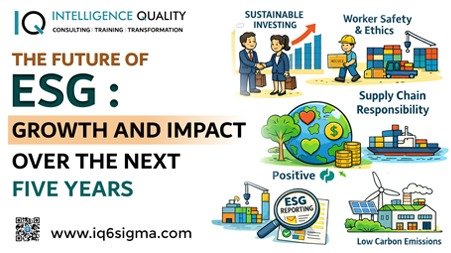
Environmental, Social, and Governance (ESG) practices have transitioned from being a voluntary corporate initiative to a critical strategic imperative. Driven by investor demand, regulatory requirements, stakeholder expectations, and global sustainability challenges, ESG is poised to become a central driver of business value and resilience over the next five years.
The Growth Trajectory of ESG
Rising Investor Pressure
Global investors are increasingly channeling capital into ESG-aligned companies. ESG-focused investment funds have grown exponentially over the past decade, and this trend is expected to accelerate:
- Analysts project ESG assets could exceed $50 trillion by 2028, representing more than a third of global assets under management.
- Institutional investors are demanding comprehensive ESG disclosures and evidence of tangible impact before allocating capital.
Corporate Adoption and ESG Integration
Organizations are moving beyond compliance-oriented ESG reporting toward strategic integration:
- ESG will be embedded in corporate strategy, operational decisions, and risk management.
- Companies are expected to invest in ESG technology, data analytics, and cross-functional ESG teams.
- ESG performance will increasingly impact board decisions, executive compensation, and shareholder relations.
The Impact of ESG on Business Practices
Sustainability as a Growth Driver
ESG will directly influence innovation and market positioning:
- Businesses that embed ESG into product design, supply chain management, and energy strategies will gain a competitive edge.
- Green products and sustainable solutions will capture consumer preference, particularly among millennials and Gen Z.
Operational Efficiency and Cost Savings
ESG-driven operational improvements are expected to:
- Reduce energy consumption and resource waste
- Optimize supply chains for lower carbon and material footprints
- Improve workforce productivity through socially responsible practices
This combination of sustainability and efficiency will enhance profitability while reducing environmental impact.
Risk Mitigation and Resilience
ESG practices will strengthen risk management in the face of global uncertainties:
- Environmental risks such as climate change and resource scarcity will be addressed through proactive planning.
- Social risks including labor disputes, employee turnover, and community resistance will be mitigated.
- Governance failures, fraud, and non-compliance risks will be reduced through data-driven monitoring and transparent reporting.
ESG and Talent Acquisition
The next five years will see ESG as a key driver of workforce attraction and retention:
- Employees, particularly in knowledge-intensive sectors, increasingly seek organizations with purpose, ethical values, and sustainability commitments.
- ESG certification and initiatives will enhance employee engagement, retention, and skill development.
- Companies prioritizing ESG will position themselves as employers of choice, particularly among younger generations who value social and environmental responsibility.
ESG Technology and Data Analytics
The next wave of ESG growth will be powered by technology and analytics:
- AI, IoT, and blockchain will improve ESG monitoring, reporting, and decision-making.
- Real-time data will allow companies to track carbon emissions, water usage, waste generation, and social impact accurately.
- Predictive analytics will help organizations anticipate ESG risks and opportunities, integrating them into strategic planning.
Long-Term Societal and Economic Impact
Over the next five years, ESG is expected to:
- Drive global decarbonization and responsible resource management
- Promote inclusive growth and social equity
- Strengthen corporate accountability and transparent governance practices
- Influence investment flows, as ESG metrics increasingly become central to capital allocation
In essence, ESG will not just be a corporate reporting requirement, but a transformative force shaping business models, markets, and societies.
Conclusion
ESG is entering a period of rapid maturation and strategic integration. Companies that treat ESG as a core business imperative rather than a compliance exercise, will benefit from enhanced efficiency, risk resilience, talent attraction, and long-term growth.
Over the next five years, ESG is expected to reshape corporate priorities, redefine leadership expectations, and create measurable societal impact. Organizations that act now will position themselves not only as sustainable businesses but as leaders of a responsible, resilient, and value-driven global economy.