

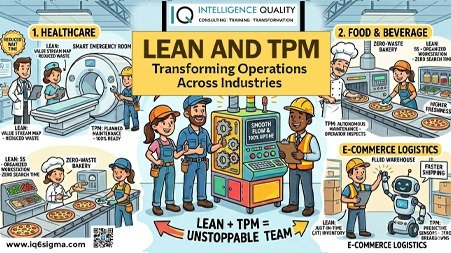
In today’s competitive business environment, operational efficiency and productivity are no longer optional - they are critical for survival and growth. Organizations worldwide are leveraging Lean principles and Total Productive Maintenance (TPM) to eliminate waste, optimize processes, and enhance equipment reliability. When applied together, Lean and TPM create a powerful framework that drives continuous improvement and sustainable business performance across industries.
Lean focuses on maximizing value for the customer by eliminating waste (Muda) in all forms - overproduction, waiting time, defects, unnecessary motion, excess inventory, and more. By streamlining processes, improving flow, and enhancing quality, Lean ensures that organizations deliver more efficiently with fewer resources.
Total Productive Maintenance (TPM) complements Lean by focusing on equipment reliability. TPM engages all employees, from operators to senior management, in maintaining and improving machinery performance. Its pillars include autonomous maintenance, planned maintenance, quality maintenance, and continuous improvement. While Lean optimizes processes, TPM ensures that the tools and equipment supporting those processes are reliable and efficient.
1. Automotive Manufacturing:
Automotive companies like Toyota and Ford are pioneers in combining Lean and TPM. Lean practices streamline assembly lines, reduce inventory, and optimize production flow, while TPM ensures machines run at peak efficiency. For example, Toyota’s implementation of autonomous maintenance on stamping machines reduced unplanned downtime by 30%, while Lean workflows improved overall assembly line efficiency.
2. Food and Beverage Industry:
In high-volume production facilities, downtime or waste can be extremely costly. Companies like Nestlé and PepsiCo use Lean to minimize overproduction and streamline packaging processes. Simultaneously, TPM helps maintain bottling and processing equipment, preventing spoilage and ensuring quality compliance. For instance, automated inspection routines under TPM prevent packaging defects, reducing product rejection rates significantly.
3. Electronics and High-Tech Manufacturing:
Precision and speed are critical in electronics production. Samsung and Foxconn integrate Lean to optimize assembly lines and reduce process bottlenecks. TPM ensures that delicate assembly machinery and cleanroom equipment operate without failure, preventing costly defects and delays. Predictive maintenance sensors combined with operator-driven inspections exemplify how Lean and TPM together minimize downtime and maximize quality.
4. Pharmaceuticals and Healthcare:
Lean principles help pharmaceutical companies like Pfizer and Novartis reduce process inefficiencies in drug manufacturing and distribution. TPM complements this by ensuring critical equipment like bioreactors, filling machines, and packaging lines are maintained proactively, reducing the risk of contamination or production halts. Hospitals also adopt Lean and TPM for medical equipment maintenance, optimizing patient care workflows while ensuring equipment reliability.
5. Small and Medium Enterprises (SMEs):
Even smaller manufacturers can benefit from Lean and TPM. For instance, a local food processing unit can implement Lean to streamline ingredient handling and packaging, while TPM practices prevent breakdowns in grinders, mixers, or ovens. The result: higher efficiency, reduced waste, and improved product quality- without major capital investments.
Lean and TPM are not just operational tools - they are transformative philosophies that can be applied across industries to drive efficiency, quality, and productivity. From automotive to healthcare, large corporations to SMEs, these methodologies enable organizations to reduce waste, improve equipment reliability, and create a culture of continuous improvement.
Organizations that invest in Lean and TPM are not just improving operations - they are building resilience, enhancing customer value, and securing a sustainable competitive edge in the marketplace.