

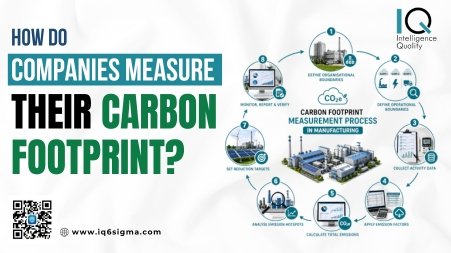
As sustainability becomes a strategic business priority, organisations across industries are under increasing pressure to understand and reduce their environmental impact. Investors, regulators, customers, and supply chain partners now expect businesses to disclose greenhouse gas (GHG) emissions and demonstrate progress toward net-zero goals.
However, meaningful climate action begins with a fundamental step:
Measuring the organisation's carbon footprint.
A carbon footprint represents the total greenhouse gas emissions generated directly and indirectly by an organisation's activities over a specific period, typically one financial year.
These emissions are measured and reported as carbon dioxide equivalent (CO₂e) to account for the varying global warming potential of different greenhouse gases.
A corporate carbon footprint is the total amount of greenhouse gases emitted by a company's operations and value chain.
This includes emissions from:
The objective is to quantify emissions accurately so organisations can identify reduction opportunities and track progress over time.
Most organisations follow internationally recognised frameworks to ensure consistency and comparability.
The most widely adopted standards include:
Among these, the GHG Protocol is the most widely used framework globally.
It classifies emissions into three categories:
The first step in carbon accounting is determining which operations and entities will be included.
Companies establish organisational boundaries using one of the following approaches:
Emissions are accounted for based on the company's ownership percentage.
Emissions are reported based on operational or financial control over activities.
This step ensures consistency in reporting across subsidiaries, joint ventures, and business units.
Once organisational boundaries are established, companies identify all emission sources across Scope 1, Scope 2, and Scope 3 categories.
Typical emission sources include:
Mapping emission sources helps organisations understand where the greatest impacts occur.
Activity data represents the measurable information associated with emission sources.
Examples include:
Activity data is typically collected from:
The accuracy of carbon accounting depends heavily on the quality of activity data.
Once activity data is collected, companies convert it into greenhouse gas emissions using emission factors.
An emission factor represents the amount of greenhouse gas emitted per unit of activity.
The calculation is straightforward:
Carbon Emissions = Activity Data × Emission Factor
For example:
If a company consumes 100,000 kWh of electricity and the grid emission factor is 0.7 kg CO₂e per kWh:
Carbon emissions = 100,000 × 0.7
Total emissions = 70,000 kg CO₂e or 70 tonnes CO₂e.
Emission factors are sourced from recognised databases and authorities, including:
Organisations should use the most recent and geographically relevant factors available.
After calculating emissions from each source, organisations aggregate the results across all scopes.
The outcome is typically expressed as:
This process creates the organisation's greenhouse gas inventory.
Measurement alone does not create value.
Companies must analyse their data to identify major emission sources.
Typical questions include:
Understanding emission hotspots enables organisations to prioritise investments and reduction initiatives.
Once the baseline is established, organisations develop emission reduction goals.
Targets may include:
Many companies align targets with the Science Based Targets initiative (SBTi) to ensure consistency with global climate goals.
Carbon accounting is an ongoing process rather than a one-time exercise.
Companies regularly monitor emissions and disclose results through sustainability reports and regulatory filings.
Common reporting frameworks include:
Increasingly, organisations are seeking third-party assurance to enhance data credibility and stakeholder confidence.
Many organisations now use digital tools to improve carbon accounting accuracy and efficiency.
Common technologies include:
Technology enables real-time monitoring and supports data-driven decision-making.
Despite growing awareness, measuring carbon footprints remains challenging.
Common obstacles include:
Scope 3 emissions often present the greatest challenge because they require collaboration across the value chain.
Measuring carbon emissions is no longer solely about regulatory compliance.
Effective carbon management can help organisations:
Most importantly, it enables organisations to make informed decisions that support long-term value creation.
The principle behind carbon management is simple:
You cannot reduce what you do not measure.
As climate-related risks and stakeholder expectations continue to grow, measuring carbon footprints is becoming a fundamental business capability.
Organisations that establish robust carbon accounting systems today will be better positioned to navigate evolving regulations, achieve sustainability goals, and compete successfully in a low-carbon economy.