

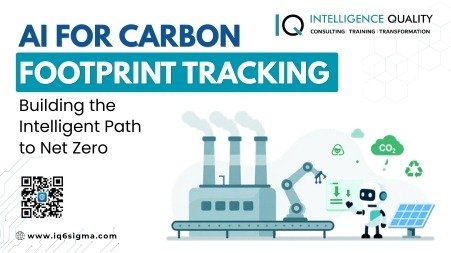
In the race toward sustainability, carbon has become the most scrutinized metric in the corporate world. Investors demand transparency, regulators enforce accountability, and consumers increasingly align with environmentally responsible brands. Yet, for many organizations, carbon footprint tracking remains a fragmented, estimation-driven exercise - complex, delayed, and often inaccurate.
This is where Artificial Intelligence steps in, not as a reporting tool, but as a transformative force.
AI is redefining how enterprises measure, manage, and ultimately reduce their carbon emissions. It is turning carbon accounting into a real-time, intelligent system, one that doesn’t just track the past, but actively shapes a lower-carbon future.
Traditional carbon tracking relies heavily on manual data collection, static emission factors, and periodic reporting cycles. Scope 1 emissions may be relatively straightforward, but Scope 2 and Scope 3 - especially across vast supply chains - introduce layers of complexity.
AI eliminates this guesswork.
By integrating data from multiple sources - IoT sensors, energy systems, logistics platforms, procurement tools - AI models can:
What emerges is a level of precision that transforms carbon tracking from an approximation into a science.
In today’s fast-moving business environment, annual sustainability reports are no longer sufficient. Leaders need real-time visibility into their environmental impact.
AI-powered carbon tracking platforms provide:
This real-time intelligence allows organizations to move from reactive reporting to proactive management, addressing issues as they arise, not months later.
For most organizations, Scope 3 emissions - those originating from suppliers, logistics, product usage, and end-of-life processes, account for the largest share of their carbon footprint. Yet, they are also the hardest to measure.
AI is unlocking this frontier.
Through advanced data modeling and machine learning:
AI doesn’t just aggregate supplier data - it intelligently fills gaps, predicts missing values, and continuously refines accuracy. The result is unprecedented visibility into the most elusive part of the carbon equation.
Tracking carbon is only the first step. The real value lies in reduction.
AI enables organizations to identify high-impact decarbonization opportunities by:
This shifts carbon management from passive monitoring to active optimization - where every decision is guided by its environmental impact.
One of AI’s most powerful capabilities is its ability to predict.
Instead of asking, “What were our emissions last quarter?” organizations can now ask:
AI-driven predictive models enable scenario planning at an unprecedented level:
Carbon reduction is no longer confined within organizational boundaries. It extends across entire ecosystems.
AI empowers companies to engage suppliers in meaningful ways:
This creates a ripple effect, where sustainability is not just enforced but shared.
With global regulations evolving rapidly, staying compliant is a growing challenge. From carbon disclosure mandates to ESG frameworks, the requirements are both diverse and dynamic.
AI simplifies this complexity by:
Forward-thinking organizations are no longer treating carbon as a compliance metric - they are integrating it into core business strategy.
AI enables:
The future of carbon tracking lies in autonomy.
Imagine systems that:
With the convergence of AI, IoT, and advanced analytics, this vision is rapidly becoming reality.
AI provides the answer. It transforms carbon footprint tracking from a complex, fragmented exercise into an intelligent, strategic capability. It empowers leaders with clarity, precision, and foresight, enabling them to act decisively in a world where sustainability defines success.